Amagabeli Hardware Cloth Review: 1/2 Inch, 19 Gauge
Our review of Amagabeli 1/2 inch 19-gauge hardware cloth: why galvanized-after-welding matters, and why the install fails before the wire does.
By ChickenGearGuide · Updated September 2026
Independent editorial review. We never accept payment for coverage, though we may earn a commission if you purchase through our links.

Verdict
We couldn't find long-run owner experience tied to this exact roll. Half-inch hardware cloth is sold by many sellers in near-identical rolls, and the discussion that exists is about hardware cloth against chicken wire as materials, or about how to fasten it, rather than about this seller, so attaching a comment here would be guesswork. The category-level picture is settled enough to score on, and it's unusually consistent: half-inch nineteen-gauge is the specification predator-proofing advice converges on, galvanizing after welding outlasts galvanizing before it at the joints, and the losses that happen through hardware cloth happen at the fasteners, the ground line and the openings rather than through the mesh. We have scored on that plus what this listing states, with the coating weight and ASTM gaps named rather than filled in.
Read full take ↓Similar run and fencing options
If one purchase decides whether your flock survives a determined raccoon, it's this one. Hardware cloth is the material that does the actual work of predator-proofing, and chicken wire, despite the name, doesn't: it keeps chickens in and it doesn't keep anything out. Our verdict on this roll is that it is the correct specification at a fair price, and that the thing most likely to fail isn't the wire.
Final scores: Build Quality 7.5, Reliability and Safety 8.0, Value 7.5, weighting to an overall of 7.7. Reliability and Safety is the strongest of the three because half-inch, nineteen-gauge mesh is the bar predator-proofing is measured against, and this roll meets it. It stops short of a nine because no wire saves a run that was stapled on lightly and left sitting on the soil.
We haven't built a run with this particular roll, and we couldn't find long-term owner reports tied to this listing rather than to half-inch hardware cloth as a category. What follows rests on the published specification, on what the mesh size and gauge mean against the animals that get in, and on the failure modes that show up in predator-proofing generally.
Why chicken wire is the wrong material, plainly
This deserves saying without hedging, because the naming causes real losses. Chicken wire is a light hexagonal netting designed to contain birds. A raccoon can tear it, a dog can push through it, and the one-inch or larger openings let a raccoon reach a paw through and take a bird apart at the fence line. It's a containment product wearing a protection product name.
Hardware cloth is a welded square mesh in a heavier gauge. That's a different material doing a different job, and every part of a run a predator can touch wants it: the walls, the roof if you have aerial predators, the apron along the ground, and above all the vents and windows, which are the openings people leave in light netting because they're small.
The specification that matters: half inch, nineteen gauge
Two numbers carry most of the decision. The half-inch mesh is about reach and passage: at one inch a raccoon gets a paw through, and rats pass openings that look far too small to matter. Half inch closes both, and half-inch nineteen-gauge is the published rat-exclusion specification. The nineteen gauge is about force: it's heavy enough that a raccoon can't tear or peel it the way it can with netting.
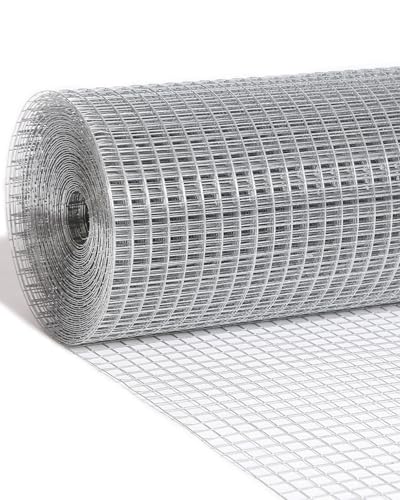
This roll is half inch by half inch at nineteen gauge, the common standard for run walls, and it comes forty-eight inches wide by a hundred feet long. That width matters more than it looks: forty-eight inches covers a run wall in a single course with no horizontal seam at raccoon height, and seams are where things get pried. Where raccoon pressure is severe, sixteen gauge is the heavier option.
Now the limit most articles skip, and the reason we don't score this higher on safety. Half inch isn't a universal barrier. Extension guidance puts least weasels through holes as small as a quarter inch, and treats a quarter inch as the threshold below which snakes can't cause predation damage. So half-inch mesh stops raccoons, rats and dogs, and it doesn't reliably stop a least weasel or a rat snake.
If either is a known problem where you keep birds, the answer isn't a heavier gauge, it's a smaller mesh: quarter-inch cloth on the coop itself, the nest boxes and every vent, with half inch doing the run walls where the threat is reach and force rather than squeezing. Sizing the mesh to the predator you have beats buying one roll and hoping.
If you're still working out how much you need and where it goes, our predator-proof run build guide works through the layout, and the hardware cloth buying guide compares mesh sizes and widths across the category.
Galvanized after welding, and why that is the real differentiator
Here's the specification that separates rolls that look identical on a listing. Galvanizing can happen before the wires are welded together or after. Galvanized before weave means the wire was coated, then welded, and welding burns the coating off at every joint, leaving thousands of bare steel points. Those joints are exactly where a roll rusts out, and the mesh fails at the welds long before the wire itself is worn.
Galvanized after welding dips the finished mesh, so the weld points get coated along with everything else. This listing states hot-dipped galvanized after welding in its title, and its feature bullets say the same thing in plainer words: galvanizing after welding so that all welding points are galvanized. That's the substantive reason to prefer a roll like this, and it makes the question to ask of any hardware cloth a question of timing: when did the galvanizing happen, before the welds or after.
It matters most where the wire stays wet. An apron lying on soil, the bottom foot of a run wall, anywhere splash and mud sit against the mesh. A galvanized-before roll in that position can show rust at the joints within a couple of seasons.
Build quality: what's published, and what isn't
What the listing commits to is useful: half-inch mesh, nineteen gauge, low-carbon steel, hot-dip galvanized after welding, forty-eight by a hundred. That's more specification than much of this category offers, and the after-welding claim is the one worth paying for.
What it doesn't give is the coating weight, usually expressed in ounces per square foot, and no ASTM designation for the galvanizing. Coating weight, together with how wet and how corrosive the site is, is what sets how many seasons the zinc lasts, so its absence is a genuine gap rather than a nitpick, and it's part of why Build Quality sits where it does. There's no tensile figure for the wire either. We couldn't verify any of the three from the listing and haven't assumed a value for them.
Reliability and safety: the wire is rarely what fails
Scored on whether it does its job, this material is the job. Half-inch nineteen-gauge mesh, properly fitted, is what stands between a flock and the animals that want it. That's why Safety is the highest of the three scores.
What holds it off a nine is that predator losses through hardware cloth are almost always installation failures rather than material failures. Three recur. Fastening is the common one: light staples pull out, and a raccoon that can get a claw behind an edge will work at it, so screws with washers or heavy fencing staples at close spacing are what actually hold. Then there's the ground: a wall that stops at the soil line is an invitation to anything that digs. Extension guidance is to bury the cloth at least twelve inches, or to lay an apron of the same cloth turned outward and pinned flat, twelve inches wide as a minimum and eighteen to twenty-four where foxes, coyotes or loose dogs are around. Last are the openings people skip, meaning vents, windows and gaps under eaves, which get used precisely because they look too small.
The other half of predator-proofing is the latch, because raccoons have hands and a simple hook or a spring latch is something they open. Two-step latches, barrel bolts with a clip, or anything needing opposable-thumb sequencing is the standard. Our predator-proof coop guide covers latches, and if your run floods or stays boggy, wet ground undermines an apron, which our muddy run guide deals with.
One limit worth naming. Nineteen gauge handles raccoons, weasels, rats, snakes and most dogs. It isn't a bear barrier and it isn't a serious deterrent to a determined large dog with time, and neither is any wire mesh in this class. If you keep birds in bear country the answer is electric, not a heavier weave.
Value
A hundred-foot roll is a real outlay, and it's also the cheapest insurance in the entire hobby measured against what it prevents. Priced per foot it undercuts buying short rolls repeatedly, and it undercuts the false economy of netting that has to be replaced after it fails, sometimes with birds.
The value case weakens in one situation, which is a small run. If you need twenty feet, a hundred-foot roll leaves you storing eighty, and the shorter sixteen-inch rolls in this category are better matched to aprons, vent covers and patching even though they cost more per foot. Measure the job before buying the big roll.
Who it's for
- Anyone building or retrofitting a run where the whole perimeter needs covering, which is where the hundred-foot roll pays.
- Keepers replacing chicken wire, which is the single highest-value upgrade most backyard setups can make.
- Damp climates and ground-level applications, where galvanized after welding earns its premium at the weld points.
- Predator-heavy areas with raccoons, weasels or rats, which is the exact threat model half-inch mesh answers.
Who should buy something else
- Small jobs. For an apron, a few vents or a patch, a sixteen-inch roll wastes less even at a higher cost per foot.
- Bear country, where mesh of any gauge is the wrong tool and electric fencing is the answer.
- Anyone who hasn't budgeted for fasteners. Washers, screws and enough staples are part of this purchase, and the wire is only as good as what holds it.
The verdict
The right material at the right specification, with the galvanizing done in the order that matters, and one caveat worth carrying: the roll can't compensate for how it goes on. Buy it, fasten it with screws and washers rather than light staples, apron or bury the bottom, and cover every opening including the ones that look too small. Our coop setup checklist sequences the build, and coop plans covers the structure it attaches to.
Our verdict
Weighted, not averaged: 35% build quality, 40% reliability and safety, 25% value. Safety counts for the most because this is gear where failure costs birds. How we score.
Build Quality
35% of the overall
The published specification is better than much of this category: half-inch mesh, nineteen gauge, low-carbon steel, and hot-dip galvanized after welding, which coats the weld points where cheaper rolls rust out first. The documentation is thinner than the spec, though. There's no coating weight, no ASTM designation and no tensile figure, and coating weight together with how wet the site is sets how long the zinc actually lasts.
Reliability & Safety
40% of the overall
Half-inch, nineteen-gauge mesh closes the reach a raccoon gets through one-inch openings and the gaps rats use, and it's the published rat-exclusion spec. Two things hold the score down. It isn't a barrier to least weasels or snakes, which extension guidance puts through a quarter inch, so a weasel or snake problem needs quarter-inch cloth on the coop and vents. And failures here are usually installation failures: light staples, a wall stopping at the soil line, an uncovered vent. It's also not a bear barrier.
Value
25% of the overall
Per foot it beats buying short rolls repeatedly and it beats the false economy of netting that fails and has to be redone, sometimes at the cost of birds. The case weakens on small jobs, where a hundred-foot roll leaves most of itself in storage and a sixteen-inch roll suits aprons and vent covers better despite costing more per foot.
Options Worth Checking Out
| Option | Role | The gist |
|---|---|---|
| Amagabeli Hardware Cloth | Our top pick | Our review of Amagabeli 1/2 inch 19-gauge hardware cloth: why galvanized-after-welding matters, and why the install fails before the wire does. |
| WERUNTEK Hardware Cloth 1/2 inch, 48in x 100ft, 19 Gauge | Alternative | The closest like-for-like: same mesh, same gauge, same roll size, and it also states hot-dip galvanized after welding covering the weld points. |
| Nueve Deer Hardware Cloth 1/2 inch, 48in x 100ft, 19 Gauge | Alternative | Same mesh, gauge and roll size, and its listing also states galvanized after welding, so on the spec that matters it makes the same claim as the main pick. |
| Land Guard Hardware Cloth 1/2 inch, 16in x 50ft, 19 Gauge | Alternative | The size to buy for a smaller job. |
| National Hardware Galvanized Barrel Bolt | Add-on | The other half of the job, and only half a latch alone. |

WERUNTEK Hardware Cloth 1/2 inch, 48in x 100ft, 19 Gauge
The closest like-for-like: same mesh, same gauge, same roll size, and it also states hot-dip galvanized after welding covering the weld points. Worth pricing against the main pick, since on the spec that matters these two claim the same thing.
Nueve Deer Hardware Cloth 1/2 inch, 48in x 100ft, 19 Gauge
Same mesh, gauge and roll size, and its listing also states galvanized after welding, so on the spec that matters it makes the same claim as the main pick. With three near-identical rolls, buy on price rather than a difference we can show.

Land Guard Hardware Cloth 1/2 inch, 16in x 50ft, 19 Gauge
The size to buy for a smaller job. Sixteen inches by fifty feet suits ground aprons, vent and window covers and patching, where a hundred-foot roll leaves most of itself in storage. It costs more per foot and wastes far less.
Frequently asked questions
Is the Amagabeli Hardware Cloth worth it?
Per foot it beats buying short rolls repeatedly and it beats the false economy of netting that fails and has to be redone, sometimes at the cost of birds. The case weakens on small jobs, where a hundred-foot roll leaves most of itself in storage and a sixteen-inch roll suits aprons and vent covers better despite costing more per foot.
How is the Amagabeli Hardware Cloth built?
The published specification is better than much of this category: half-inch mesh, nineteen gauge, low-carbon steel, and hot-dip galvanized after welding, which coats the weld points where cheaper rolls rust out first. The documentation is thinner than the spec, though. There's no coating weight, no ASTM designation and no tensile figure, and coating weight together with how wet the site is sets how long the zinc actually lasts.
Is the Amagabeli Hardware Cloth reliable and safe for a flock?
Half-inch, nineteen-gauge mesh closes the reach a raccoon gets through one-inch openings and the gaps rats use, and it's the published rat-exclusion spec. Two things hold the score down. It isn't a barrier to least weasels or snakes, which extension guidance puts through a quarter inch, so a weasel or snake problem needs quarter-inch cloth on the coop and vents.
You Might Also Need
Accessories worth grabbing alongside your purchase
