Omlet
Omlet Eglu Go Review: A 2-3 Hen Coop at a Steep Price
Our independent verdict on the Omlet Eglu Go: superb easy-clean plastic, but a 2-3 hen coop most keepers can beat on space for less.
By ChickenGearGuide · Updated September 2026
Independent editorial review. We never accept payment for coverage, though we may earn a commission if you purchase through our links.
Verdict
We usually lean this section on years of owner experience with a product. For the Eglu Go we couldn't find that evidence at any useful depth. The larger Eglu Cube has a real body of long-term owner reports, and we lean on it in our Cube review; the Go doesn't, so pinning a verdict on this exact model to owner accounts would be guesswork, and we aren't going to dress the Cube's evidence up as the Go's. So this verdict rests on the published spec, on the space math, and on what the Go shares with the Cube by design. Our read on the class is straightforward. The Omlet plastic and the easy cleaning are a genuine strength, the sealed shell is a strong last barrier inside a secure run, and the price against the two-to-three hens the space math supports is the weak point. Where the listing is silent, on the interior floor, the run width and whether the Go carries the Cube's insulation, we have said so rather than fill the gaps, and we would revisit the scores if substantial owner reports on this specific coop ever surface.
Read full take ↓Similar coops
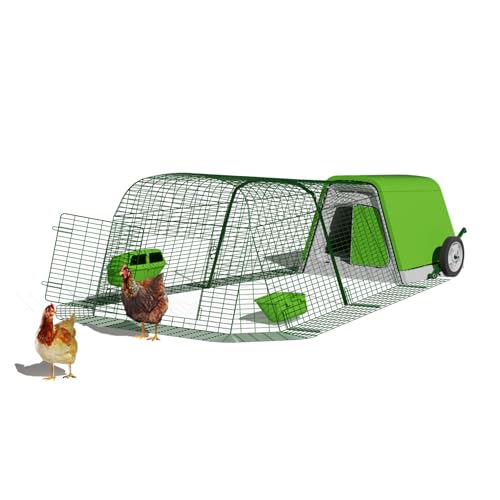
The Omlet Eglu Go Chicken Coop is the small sibling of the Eglu Cube, and it's a good little coop that most keepers should still walk past. It's the same easy-clean Omlet plastic in a much smaller shell, it ships with a short run and a set of wheels, and Omlet sells it as a compact starter or broody coop. Our verdict is that the last part is the accurate one: this is a home for two or three standard hens, not the flock most buyers picture when they spend this kind of money.
Omlet rates the Go for up to three large hens or four bantams. We reach a slightly smaller number the same way we do for every coop, by holding the maker's hen count against the space a hen actually needs. About four square feet of coop floor per standard bird is the rule keepers use, so three large hens want roughly twelve square feet of floor, and a coop Omlet itself calls compact is unlikely to be carrying twelve. The listing doesn't publish an interior floor measurement you could use to check, so we treat the top of its own range as optimistic and land at two to three hens. Bantams, which need less floor, sit better inside the four the label allows.
We haven't held this coop, run it through a winter or counted birds into it. Multi-year owner accounts of this specific model didn't turn up on our end, so the verdict rests on the specs and the class. The larger Eglu Cube has years of owner reports behind it and its own review here; the Go doesn't, so we work from the dimensions the listing publishes and the ones it leaves out, and from how the Go compares to the Cube, which we do have evidence on. Numbers the listing never prints don't get printed here either, and we won't fake them.
The short version
What it gets right:
- It's the same easy-clean plastic as the pricier Cube. The listing calls it an easy-to-clean plastic house, and that plastic is Omlet's whole build case: it hoses down, it doesn't rot, and it doesn't soak up mites in the grain the way wood does.
- It ships with wheels, so one person can move it. For a broody hen you need off the flock, or a bird you're isolating for a few weeks, a coop you can wheel to a quiet corner is exactly the right tool.
- It's small on purpose, and Omlet says so. As a compact starter or broody coop for one to three birds it's doing the job it was built for, not stretching to cover a job it wasn't.
- It arrives as a coop plus a 6ft run, so it's a complete setup for a couple of hens out of the box rather than a bare box you have to build a run around first.
What it gets wrong:
- The price is the headline against it. This is a near-four-figure coop, and for that money most keepers can house more birds in more space, which is the whole reason we send most readers elsewhere below.
- The capacity is optimistic at the top. Omlet's up-to-three-large-hens rating works out, by the four-square-feet rule, closer to two or three standard birds, and a buyer expecting a coop to grow a starting flock into will find it doesn't.
- The listing publishes no interior floor size, gives the run only as 6ft with no width, and doesn't state a wall thickness, so you can't check either the capacity or the weatherproofing claims before it arrives.
- The bundled 6ft run is short. Our read, from the space math and from what the Cube's larger run does, is that a couple of active hens outgrow it and you end up attaching a bigger run, which changes the real cost.
Which flocks and setups it fits
Buy it for a small, fixed job and it does that job well. A broody hen you need to move off the main flock, a bird recovering from a squabble, a pullet or two you're hardening off before integration, or a first pair of standard hens in a suburban yard with a secure run around them. The wheels and the small footprint are the point in every one of those cases, and the easy-clean plastic means the coop you use for an isolation case strips down and hoses out between birds instead of holding damp and mites. For that keeper the Go is a good buy, and the price stings less because you're buying the cleaning and the portability, not the capacity.
Send most people somewhere else. If you're buying the one coop your starting flock of four to six hens will live in year round, this isn't it, and the better move is a bigger coop or, better, far more run space for the money. Anyone whose main goal is the most coop per dollar shouldn't be here at all; a near-four-figure spend on two or three hens is the opposite of that. And if you want the Omlet plastic but have more than about three birds, the larger Eglu Cube is the model that fits, at a higher price again. The Go is right for a tiny flock you never plan to grow, and wrong for almost everyone treating "starter coop" as "first coop we'll expand from."
The specs that matter
What the listing tells you is short. The coop is plastic and easy to clean, it comes from Omlet, it ships with a 6ft run and wheels, and Omlet rates it for up to three large hens or four bantams as a compact starter or broody coop. That's close to the whole spec sheet. There's no published interior floor dimension, no run width to go with the 6ft length, no wall thickness and no roost or nest box detail. With the sheet this thin, that absence is itself the finding, because the measurement that would let you test the three-hen claim, the coop floor, is the one the listing doesn't print.
So we hold it against the rule instead. Work through how much space chickens actually need and two numbers do the job: about four square feet of coop floor per standard hen, and about ten square feet of run per bird. Three large hens by the floor rule want roughly twelve square feet of coop, and a shell Omlet itself calls compact almost certainly falls short of that, which is why we read the top of its range as optimistic and settle at two to three standard hens. The run rule bites harder. Three hens want about thirty square feet of run, and the bundled run is given only as 6ft long, with no width printed, so we can't compute its area and won't pretend to. Even read generously, a 6ft run is short for three active birds, and that's before you subtract the coop footprint sitting inside it.
One spec gap is worth flagging on its own, because it's a seam we couldn't close. The Cube's listing markets the shell as weatherproof, cool in summer and warm in winter, which is the twin-wall insulation Omlet is known for. The Go's listing says none of that. It says plastic and easy to clean and stops there. We don't know from the listing whether the Go shares the Cube's insulated twin wall or uses a simpler single-skin plastic, and rather than assume the two coops are built the same we're telling you the Go's own page doesn't claim the insulation. If cold or heat performance is why you're looking at Omlet, that's a question to put to Omlet before you buy, not one this listing answers.
Before ordering, we would want the interior floor dimension, the run width, and a straight answer on the wall build, and none of the three is in the listing. If you buy it anyway, measure the coop floor the day it arrives and divide by four square feet to get the count that actually fits. It will almost certainly land at or below the two-to-three we read here, and under the three on the label.
How it keeps the flock safe
The safety case for any Omlet coop starts with the shell, and it's a real strength. Sealed plastic gives a raccoon nothing to pry a paw into, no seam to chew and no soft corner to work, so as the last barrier over a sleeping flock a plastic Omlet is about as good as a coop gets. We score that on the shared Omlet design and the plastic the listing confirms, not on a Go-specific break-in report, because we don't have one. The same logic that makes the Cube secure applies to the Go: the material is the defense, and the material is good.
Two gaps come with that design, and both are worth planning around. The first is vermin. The vents that let an Omlet breathe are also how rats find their way in, and a rat gets through a smaller gap than you would guess. That's a known issue on the plastic Omlets generally, and there's no reason the Go is exempt, so run half-inch 19-gauge hardware cloth over the run and keep feed out of the coop overnight. The second is the run itself. A 6ft bundled run is a small enclosure, and a small run is a weaker predator perimeter than a big walled and skirted one, simply because there's less of it and it sits closer to the coop. Stand the whole thing inside a run you have secured with hardware cloth and an apron of the same wire laid outward along the base so nothing digs under, and the light bundled run stops being the weak point.
Ventilation still matters even on a coop this small, and it cuts the opposite way to what instinct says. Damp, not cold, is what gives a hen frostbite, so the vents that let vermin in are also what keep the coop dry enough to protect combs and toes in winter. Don't tape them shut chasing warmth. A hen fluffs up and heats the pocket of air around her body better than a sealed box does, and a stuffy coop is what actually hurts her.
Build quality and living with it
The build is the reason the Go earns a high mark, and it's the same reason as the Cube: Omlet plastic. It doesn't rot, it doesn't warp with damp, it doesn't hold mites in the grain, and it doesn't need repainting, and the listing confirms the easy-clean plastic that all of that rests on. For an outdoor structure that lives in weather all year, a shell you hose down instead of scrape and seal is a genuine advantage over the wooden coops at a fraction of the price. We can't point to a Go owner seven years in the way we can for the Cube, so the number reflects the material and the maker rather than a long-term Go report, and we would rather say that than imply evidence we don't have.
Living with it is a small-coop experience, and the wheels are the part that makes the small size work in its favor. You can move the Go to fresh ground, roll it into shade, or wheel a broody hen away from the flock without dismantling anything, which is exactly what a compact isolation coop is for. The trade is room. Cleaning a coop this size means reaching in rather than walking in, and for two or three hens that's manageable and part of the deal. Push it to the four bantams or the three large hens on the label and the same easy-clean shell becomes a cramped one you're cleaning more often, because more birds in a small box means more mess in less space.
How it compares
The obvious step up is the Omlet Eglu Cube, the coop the Go is a shrunk-down version of, and it's worth seeing what the extra money buys. The Cube is the same easy-clean plastic in a larger shell that owners land at around six hens in practice, its listing does claim the weather performance the Go's doesn't (the twin-wall build Omlet is known for), and years of owner reports stand behind it, including one keeper seven years in with no repairs. It costs more again, and its own value case is thin for the same reason the Go's is. But if you want Omlet plastic for more than about three birds, the Cube is the model that actually fits, and the Go isn't the one to stretch.
The better spend, if the real problem is room, isn't a plastic Omlet at all. A large metal walk-in run gives a flock a genuine outdoor space for a small fraction of what the Go costs, and getting birds out of a tight coop and into real run space is what prevents the crowding a small coop causes. Pair a modest shelter with a run like that and the flock is better off than it would be shut in a premium plastic box with a 6ft run bolted to the side. That's the trade we would make for most keepers, and it's the honest answer to "how do I get more coop for my money," which is that you don't buy a smaller premium coop, you buy space.
Setting it up
There's very little assembly to speak of on a plastic Omlet, which is part of the appeal, so the setup work is mostly siting it right. Put the Go, and its 6ft run, inside a larger run you have made predator-secure with half-inch 19-gauge hardware cloth on the walls and an apron of the same wire pinned or buried outward along the base. That apron is what stops a digging predator, because a fox or a raccoon digs at the wall, not a foot out from it. The plastic shell will hold the line at the coop; the run is where the real predator work happens, the same as it is with any coop.
Then use the coop for what it is good at. Roll it to a quiet corner for a broody hen or an isolation case, keep the vents clear and high so the coop stays dry, and hose the plastic down on a schedule so the one thing you paid a premium for, the cleaning, actually gets used. Keep feed out of the coop overnight so the vents don't become a rat door. And if you're already thinking about adding birds, stop and size the run first, because the coop will hit its limit long before your enthusiasm does.
The bottom line
We would buy the Go for one kind of keeper: someone who wants Omlet's easy-clean plastic and a coop they can wheel around, for two or three hens, a broody, or an isolation case, and who has decided the cleaning and the portability are worth the money. For that keeper it's a genuinely good little coop and the price is a fair trade. For the far more common buyer treating a near-four-figure "starter coop" as the first coop a growing flock will live in, it's the wrong buy, because Omlet's own up-to-three-hens rating reads closer to two or three standard birds once you apply the space math, and the same money buys a lot more room elsewhere.
Final scores: Build Quality 8.5, Reliability and Safety 8.0, Value 5.0, which weight to an overall of 7.4. The build and the safety carry it, on the strength of the Omlet plastic and the sealed shell, and the value drags it back to a coop we recommend only to a narrow reader. Two things would move the number: substantial long-term owner reports on this exact model, which we couldn't find and which would let's score the build on evidence rather than the brand, and a listing that finally publishes the interior floor and confirms the wall build. So we'll level with you about the gaps we couldn't close, not paper them over with numbers we invented.
Our verdict
Weighted, not averaged: 35% build quality, 40% reliability and safety, 25% value. Safety counts for the most because this is gear where failure costs birds. How we score.
Build Quality
35% of the overall
The Go is the same easy-clean Omlet plastic as the Cube, from the same maker, and the listing confirms the plastic and the easy-clean claim. Plastic that doesn't rot, warp or hold mites in the grain is a real build advantage over wooden coops, which is why the number is high. It sits on the brand and the visible material rather than a Go-specific long-term report, which we couldn't find, and the listing doesn't confirm the twin-wall insulation the Cube advertises.
Reliability & Safety
40% of the overall
A sealed plastic shell gives a raccoon nothing to pry at, which makes it a strong last barrier inside a secure run, and we score that on the shared Omlet design the listing confirms. Two gaps come with it: rats can find the vents, and the bundled 6ft run is a small, weak perimeter on its own. Both are closable with hardware cloth and a bigger secured run. We have no Go-specific break-in report, so the caution is priced in.
Value
25% of the overall
This is where it loses. A near-four-figure price for a coop our space math puts at two to three standard hens is poor coop-per-dollar, worse even than the larger Cube gives you. It keeps a narrow value case as the cheapest route into Omlet plastic in a movable footprint for a tiny flock or a broody box. For anyone chasing space, the same money buys far more room, so most readers should spend it elsewhere.
Options Worth Checking Out
| Option | Role | The gist |
|---|---|---|
| Omlet Eglu Go | Our top pick | Our independent verdict on the Omlet Eglu Go: superb easy-clean plastic, but a 2-3 hen coop most keepers can beat on space for less. |
| Omlet Eglu Cube Large Chicken Coop | Premium option | The step up if you want Omlet plastic for more than about three birds. |
| Large Metal Walk-in Chicken Run, 19.6 x 9.8 ft | Alternative | If the real problem is room, spend here instead of on a small premium coop. |
| Petsfit Wooden Chicken Coop with 71-inch Run | Alternative | A cheaper real-wood coop-and-run for three or four hens, from a brand worth trusting. |

Omlet
Omlet Eglu Cube Large Chicken Coop
The step up if you want Omlet plastic for more than about three birds. The larger shell lands owners near six hens, its listing claims the weather performance the Go's does not (Omlet's twin-wall build), and years of reports back it. The price is still the catch.

Large Metal Walk-in Chicken Run, 19.6 x 9.8 ft
If the real problem is room, spend here instead of on a small premium coop. This metal walk-in run gives a flock far more space for a small fraction of the Go's price. It is a run, not an insulated coop, so add a roost and a simple shelter inside it.

Petsfit Wooden Chicken Coop with 71-inch Run
A cheaper real-wood coop-and-run for three or four hens, from a brand worth trusting. Measure the enclosed sleeping area against four square feet a bird before you trust the label, because like every prefab its hen count runs ahead of its floor.
Frequently asked questions
Is the Omlet Eglu Go worth it?
This is where it loses. A near-four-figure price for a coop our space math puts at two to three standard hens is poor coop-per-dollar, worse even than the larger Cube gives you. It keeps a narrow value case as the cheapest route into Omlet plastic in a movable footprint for a tiny flock or a broody box.
How is the Omlet Eglu Go built?
The Go is the same easy-clean Omlet plastic as the Cube, from the same maker, and the listing confirms the plastic and the easy-clean claim. Plastic that doesn't rot, warp or hold mites in the grain is a real build advantage over wooden coops, which is why the number is high. It sits on the brand and the visible material rather than a Go-specific long-term report, which we couldn't find, and the listing doesn't confirm the twin-wall insulation the Cube advertises.
Is the Omlet Eglu Go reliable and safe for a flock?
A sealed plastic shell gives a raccoon nothing to pry at, which makes it a strong last barrier inside a secure run, and we score that on the shared Omlet design the listing confirms. Two gaps come with it: rats can find the vents, and the bundled 6ft run is a small, weak perimeter on its own. Both are closable with hardware cloth and a bigger secured run.

