Best Chicken Coop 2026: What Is Actually Worth Buying
By ChickenGearGuide · Updated September 2026
Independent editorial guide. We never accept payment for coverage, though we may earn a commission if you purchase through our links.
Quick Take
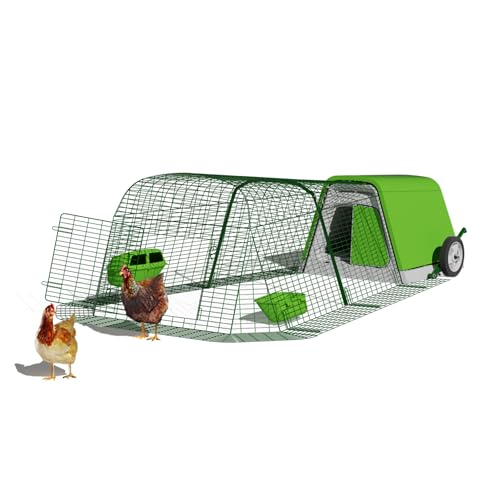
The best-built coop we have put through a review is the Omlet Eglu Cube, and it's also the most expensive by a wide margin. What the money buys is wipe-clean plastic that doesn't harbor mites, a double-wall shell, and latches a raccoon can't work, not extra room. If that price makes you wince, and it makes us wince, a right-sized wooden coop from Petsfit or Aivituvin does the job for a small flock at a fraction of it, as long as you buy on the real floor space and not the box.
That's the whole game with prefab coops: almost every one is sold for about twice the hens it can actually hold. Measure the enclosed sleeping area, divide by four square feet, and that's your honest bird count. Do that one sum before you buy anything below and you'll avoid the mistake that fills these listings with unhappy buyers.
Five coops we have reviewed, ranked by who each one is really for: See picks ↓

Search "best chicken coop" and you get a wall of near-identical wooden boxes and a couple of expensive plastic ones, all photographed to look bigger than they are. We have reviewed eight of them, and the short version is that none is a slam dunk. The plastic Omlets are the best made and the best at keeping a flock safe, and they cost as much as a used car for the space of a garden shed. The wooden coops are cheaper and look the part, and most are rated for roughly twice the birds they can hold.
So the useful question isn't "which coop is best" but "which coop is right for your flock at a price you can live with, once you strip out the capacity fantasy." That comes down to four things: real floor space, whether the build is worth trusting overnight, ventilation, and how it holds up in the weather. Price sorts itself out after that.
We haven't assembled these coops ourselves, and long-term owner accounts of most prefab models are thin, so where a listing goes silent we would rather tell you that than invent a number to fill the gap. What follows leans on the published dimensions, the four square feet per bird rule, and the eight coops we have already reviewed in depth.
The one number that decides everything: real floor space
A laying hen needs about four square feet of coop floor and eight to ten of run. The coop is only where they sleep and lay, so the floor figure is modest, which is exactly why the capacity claims get away with so much. A coop advertised for eight chickens is very often a four-bird coop with a run bolted on, because the headline count quietly folds the run in as living space. Crowd a flock past that four-square-foot line and you get feather-picking, foul water, and disease, so the real capacity is the number that matters.
Before you order any coop, find the enclosed sleeping area in the listing, divide by four, and treat that as the bird count. It's usually about half the box number. Our coop size calculator does the sum and adds the run, nest box, and roost figures alongside it.
Plastic or wood
This is the real fork. Plastic, which on Amazon means Omlet, wipes clean, gives red mite nowhere to hide, and doesn't rot or need re-treating, and the full-size Cube adds a double-wall shell for a bit of insulation. The catch is the price, which is high, and the fact that you're paying that price for a fairly small footprint.
Wood is cheaper, looks like what people picture when they think of a coop, and comes in bigger footprints for the money. The trade is upkeep and hygiene. Untreated softwood, which is what almost every budget coop is made of, drinks up water at the joints and needs a coat of preserver on day one and again every year or two, and the cracks it opens are where mites live. A wooden coop is the right answer for plenty of keepers, but it's a coop you maintain, not one you forget.
The coop isn't your predator defense
Every prefab coop here, plastic or wood, has thinner wire and flimsier latches than the marketing implies, and the sliding pop-door panels on the wooden ones won't hold a determined raccoon. That isn't a reason to reject them, it's a reason to be clear about what a coop does. The coop keeps weather and casual trouble out. The thing that actually stops a predator is the run: half-inch hardware cloth over every opening, with an apron staked or buried around the base, and a latch a raccoon can't turn. Buy the coop for shelter and cleaning, and spend separately on the wire that makes the whole setup safe.
The first upgrade on most wooden coops is the hardware. Swap the token barrel bolts for latches with a carabiner or a spring clip through them, because a raccoon has all night and hands enough to work a simple slide bolt.
Ventilation, which most prefabs get wrong
Damp, not cold, is what gives a hen frostbite, and a sealed coop full of birds turns damp fast because hens breathe out and their droppings give off a lot of water overnight. A coop needs vents up high, above roost height, where that wet air can leave without blowing across the birds. Most prefab coops ship with too little ventilation and no easy way to add more, which is worth checking before you buy: look for gable vents or a mesh strip near the roof line, not just the pop door and a couple of low windows. If a coop is sealed tight, you'll be drilling vents into it in the first winter.
Living with it, and the weather
Flat-pack softwood coops arrive as panels you assemble, and the assembly is where the cheap ones show themselves: go slow, don't overtighten the screws until the frame catches, and pre-drill if the wood feels like it'll split. Once it's up, the weather goes looking for the joints. A factory finish helps for a season, and after that the coops that last are the ones whose owners keep a coat of preserver on them. The plastic coops skip all of this, which is a real part of what their price buys.
How the coops we reviewed stack up
The Omlet Eglu Cube is the best full-size coop we have reviewed, and it's our top pick for anyone whose budget reaches it: the build, the cleaning, and the predator resistance are all a clear step above everything else, and while Omlet still markets the Cube above the six hens owners actually land on, it oversells the space far less than the wooden coops do. The smaller Omlet Eglu Go does the same job for two or three hens in a small yard, and it's the highest-scoring coop we have reviewed on our own scale, held back only by costing as much as the Cube for a fraction of the room. If the Omlet price is out, the Petsfit is the wooden coop we would reach for first, the cheapest here we would still trust, with the Aivituvin and the larger Best Choice 80-inch as fair alternatives when you want a different size. All three are honest buys only if you hold them to the four-square-foot rule rather than their listed bird count.
What we wouldn't buy is the coop sold as a two-to-four-hen home that works out, on its real floor, to one or two birds, and the mobile tractor unless a tractor is specifically what you want. A coop that lies about its capacity by the widest margin is the one most likely to leave a new keeper with a crowded, sick flock and a bad first year.
Recommended
Products related to this guide.