RentACoop
RentACoop Treadle Feeder Review: Worth the Money Only If You Fight Rats
Our independent verdict on the RentACoop 40 lb treadle feeder: metal and rainproof, it earns its price only if you are fighting rats.
By ChickenGearGuide · Updated September 2026
Independent editorial review. We never accept payment for coverage, though we may earn a commission if you purchase through our links.
Verdict
We usually lean this section on years of owner experience with a product. For this feeder we couldn't find that evidence. The treadle format is discussed widely and the gold-standard names come up often, but substantial long-term owner reports on this exact RentACoop model weren't there to read, so pinning a quote to this listing would be guesswork rather than evidence. Our read on the treadle format as a whole is settled and it shapes the scores. The mechanism does take feed out of circulation between meals, which is the real rodent answer, and every treadle shares the same two weaknesses: the birds have to be trained onto the plate and some flocks are slow to take to it, and the feeder protects the feed rather than the flock, so it's no substitute for hardware cloth on the run. We have taken that as background and scored this feeder on what the listing publishes plus our category read, not on owner reports we can't stand behind. The single biggest open question is how it holds up against the Grandpa's over several winters, and nobody we could find has run both long enough to say.
Read full take ↓Similar feeders
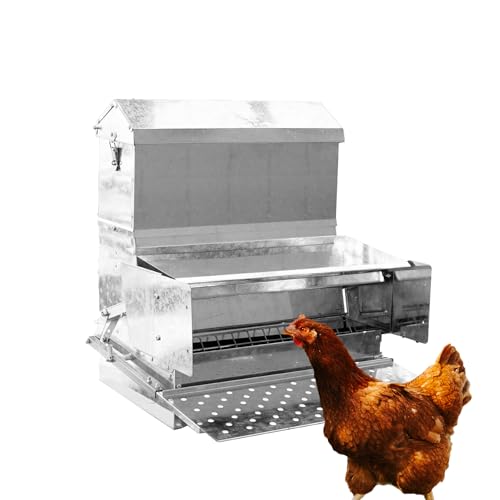
The RentACoop 40 lb Automatic Treadle Chicken Feeder is the feeder we would put in a run that has rats in it, and the mechanism is the whole reason. A hen steps onto the metal plate, her weight lifts the lid, she eats, and the lid drops shut the moment she steps off. A rat or a mouse is too light to work the plate, so the feed sits behind a metal lid whenever a bird isn't actively eating, which is what the "rat resistant" and "no waste" on the listing describe, and it's a genuinely good answer to the twin problem of feed on the ground and rodents in the run. It's also a real investment, and our verdict is that most flocks don't need one.
The problem it solves is a specific one. An open feeder or a plastic gravity hopper spills feed onto the ground, and feed on the ground feeds mice and rats as surely as it feeds the flock. A treadle feeder keeps that feed covered until a bird stands on the plate, which takes the food out of circulation between meals and leaves the rodents nothing to come for. If you're fighting rats, that's worth paying for. If you have no rodents and your only complaint is a bit of scattered feed, you're about to spend a lot to solve a problem a set of feed ports would fix for a fraction of the money, and we send you there below.
Here's the limit on everything that follows. We haven't filled one of these, run it through a winter, or watched a flock learn the plate, and we aren't going to pretend otherwise. Long-term owner accounts of this exact model eluded us too, the kind that would tell us how the metal holds up after three years outdoors or how often a flock simply refuses the treadle. This verdict leans on what the listing publishes, on how a treadle feeder works as a design, and on our read of the feeder category from the Grandpa's Feeders treadle we review in full and the DIY and port options in our chicken feeder buying guide. A spec the listing leaves off stays off our page, because we won't guess at it.
The short version
What it gets right:
- The treadle is the only feeder design that takes the feed out of circulation between meals, so a rat or a wild bird gets nothing out of it. That's the entire reason to buy one.
- The body is metal and the listing calls it rainproof with a covered feed bin, which is a real step up from the plastic gravity feeders it sits next to on the shelf.
- Forty pounds is a large hopper. By our own math, a laying hen eats about a quarter pound of feed a day, so ten hens empty it in roughly two weeks, and filling it's a twice-a-month job rather than a daily one.
- There's no power, no battery and no electronics. Every failure it can have is mechanical and visible the moment you lift the lid, which is more than the app-controlled feeders can say.
- At its price it undercuts the Grandpa's it's most often cross-shopped against, so it's the cheaper way into the gold-standard treadle bracket.
What it gets wrong:
- The birds have to learn the plate, and that's your job for a week or two. A treadle a flock never takes to is a worse outcome than the feed scatter you bought it to fix, because a bird that won't work the lid doesn't eat.
- It's a large steel box with a plate sticking out in front, so it wants a flat wall and floor space. A compact run is worth measuring before you order, not after.
- The listing publishes no dimensions, no opening weight and no metal gauge, so you can't check the footprint or how heavy a bird it needs before it arrives. That absence is a finding in itself.
- It's rat resistant, not raccoon proof. Nothing about a feeder is a predator barrier, and buying one won't change what you need on the run walls.
- We couldn't find long-term owner reports on this exact model, so how the metal wears after several winters outdoors is a question we can't answer yet.
Which flocks and setups it fits
Buy it for a flock of standard-size hens with a rodent problem you can actually see. Rats moving in the run at dusk, feed going down overnight, droppings in the tray in the morning: that's the situation a treadle feeder exists for. The 40 lb hopper suits a bigger flock, somewhere around ten to twenty standard birds, because a hopper that size on three hens is mostly paying for capacity you won't use before the feed goes stale. Orpingtons, Australorps, sex-links, Rhode Island Reds, the four-pound-and-up layers that aren't shy about food and are heavy enough to work a plate without thinking about it.
The listing says it suits bantams and ducks as well as standard chickens, and the format does work for lighter birds, with one caveat we would flag before you buy. A treadle needs weight on the plate to lift the lid, and the lighter the bird the more the plate tension matters. The listing doesn't publish an opening weight for this model, so we can't tell you the floor. If your flock is silkies, true bantams, or anything under a pound or so, that's a question to settle with the seller before ordering rather than a thing to find out in the run. It's exactly the kind of number the Grandpa's publishes and this listing doesn't.
Two readers should spend the money somewhere else. Keepers whose real complaint is scattered feed rather than rats, because a set of no-waste feed ports fitted to a bucket solves the scatter for a fraction of the price and does nothing about rats either way. And keepers running three or four hens in a small run, who don't need 40 lb of capacity and may not have room for the box. We would push back on one more group too, the keepers buying this to end a rat infestation outright. A treadle feeder removes the food. Removing the food stops the population growing and does nothing about the animals already living under the coop, so budget for a trap alongside the feeder, not instead of it.
The specs that matter
What the listing tells you is short, and worth reading carefully because the words are doing exact work. The feeder is metal, it holds 40 lb, it's an automatic treadle with a step-on plate, and the listing calls it rainproof, no waste, and a covered feed bin. It's described as suiting chickens, bantams, ducks and pheasants. That's close to the whole published spec sheet. The one word we wouldn't stretch is "resistant". The listing says rat resistant, not rat proof, and we're going to hold it to the weaker claim it actually makes.
What the listing doesn't publish is the part a careful buyer wants most. There's no interior dimension, no external footprint, no weight, no metal gauge and no opening weight for the treadle. For a careful spec read that absence is the finding, because the footprint and the opening weight are the two numbers that decide whether the box fits your run and whether your birds can work it, and neither is printed. The listing says "Metal" and stops there, so we won't tell you it's galvanized steel, because the listing doesn't, and guessing the coating is exactly the kind of invented spec we don't do.
The number worth doing yourself is the capacity math. A laying hen eats roughly a quarter pound of feed a day, so a 40 lb hopper is about 160 hen-days of feed: a fortnight for ten birds, three weeks or so for six. That's our arithmetic off a standard consumption figure, not a claim from the listing, and it's the right way to size the hopper to your flock. Pellets flow through any hopper more cleanly than crumble, which tends to bridge, so if you run this feeder we would run pellets through it and watch the tray fill for the first few days.
How it keeps the flock safe
The safety case for a treadle feeder is indirect, and most of it is about rats. Rats in a coop take eggs, kill chicks, chew through timber and carry in mites, and an open hopper of layer feed sitting out overnight is the standing invitation. A lid only a bird heavy enough can lift takes the feed out of circulation between meals, which removes the reason rodents come to the run at all, and it does that without a trap, a poison, or a nightly chore for you. That's the design working as intended, and on paper it's a good design. We're judging the spec sheet here, since no owner has reported whether this specific box keeps that lid shut after a few years of weather.
What it doesn't do is keep anything out of your run. A treadle feeder is rat resistant, not a predator barrier, and a raccoon has hands and all night. Nothing about buying this feeder changes what the run itself needs, which is half-inch 19-gauge hardware cloth on the walls with a buried or aproned skirt along the base so nothing digs under. If you're counting on the feeder to be part of your predator plan, it isn't, and we would rather say that plainly than let the "rat resistant" on the box read as more than it is.
The failure mode that would worry us is quieter than a break-in. If a flock hasn't learned the plate, or the treadle is too stiff for the lighter birds in the flock, the feeder looks full from ten feet away and the birds aren't being fed. That's the real safety risk with any treadle, and it's behavioral rather than mechanical. Until you have watched every bird in the flock work the lid at least once, lift it yourself and look at the tray when you walk past. We can't tell you how often flocks refuse this exact model, because the owner reports that would answer it aren't there to read.
Build quality and living with it
The build story starts and mostly ends with the word "metal". A metal body, a rainproof cover and a covered bin put this in a different class from the plastic gravity feeders that crack in the sun and take on water, and that's a genuine point in its favor. It's also where the specs-only limit bites hardest. The listing doesn't publish a gauge or a coating, so we can't tell you whether the sheet is heavy enough to shrug off a dropped lid for ten years or thin enough to dent, and there's no body of long-term owner reports on this model to fill that gap. We score the design as sound and hold the number back from the eights because we can't verify how it wears.
Living with it is mostly filling it and then leaving it alone. Ten hens go through the 40 lb hopper in about two weeks, so it's two fills a month against a daily scoop, and the covered bin keeps the feed dry in between if the rain claim holds up. The one moving part is the treadle-and-lid linkage, and a treadle plate that sits in wet bedding is the most common self-inflicted problem with any feeder of this type, because the plate stops returning cleanly and the lid stops sealing. Set it on something solid and dry and that mostly goes away. The lid on a metal feeder is loud, which matters more than it sounds, because a nervous flock can be put off the whole thing by the clang.
Feed waste is the claim we would treat most carefully. The listing sells it as no waste, and a treadle lid does control who reaches the tray, which stops the wild birds and the overnight raiders. What it doesn't control is what a hen does with her beak once she's standing at an open tray, and a bird that flicks feed out of a tray will keep flicking it. If cutting waste is the whole reason you're shopping, a treadle is an expensive way to get there, and the feed ports in the picks below are the cheaper answer.
How it compares
The unit to weigh this against is the Grandpa's Feeders 40 lb treadle, and it's the more expensive of the two. What the extra money buys is a track record. Grandpa's publishes the numbers this listing leaves blank, an opening weight and a footprint and a floor for how light a bird it'll open for, and there's a body of owner reports behind it that runs to years without rust or breakage. The RentACoop doesn't have that record yet, or at least not one we could find. So the comparison is that the RentACoop is the cheaper way into the same format, and the Grandpa's is the one with the longest paper trail, and we haven't found a single keeper who has run both long enough to tell you which metal lasts. That's the largest hole in this review, and we would rather name it than paper over it.
For a lot of readers the real competitor isn't another treadle at all. If the problem is feed on the ground rather than rats in the run, a set of no-waste feed ports drilled into a food-safe bucket fixes the scatter for very little money, and our feeder buying guide walks through that whole decision. A port kit keeps no rodents out unless you cap it at night, so it's a waste fix and not a rat fix, but for the many keepers whose only real problem is billed-out feed it's the right buy and this treadle is overkill. The cheap end of the treadle category, a VEVOR-style 40 lb feeder at a fraction of the price, is the third option: full capacity for the keeper who wants to find out whether their flock will even work a plate before spending big, with the fair warning that the cheaper the treadle the lighter the metal and the stiffer the plate.
Where we part company with the standard advice is on what a treadle feeder is for. The usual recommendation in a rat thread is to buy one, with the implication that it solves the rat problem. It doesn't solve it. It removes the food, which stops the population growing and leaves the existing animals to look elsewhere. Buy this feeder as feed storage that a rat can't open, keep the trap-and-exclusion job separate in your head, and you won't be disappointed by a feeder that was only ever going to do half of it.
Setting it up
Set it on something flat and dry, against a wall, in the part of the run that stays driest. A paver or a scrap of ply keeps the base out of the mud and stops the treadle plate sinking into bedding, which is the failure that makes a treadle stop sealing. Put it somewhere you walk past every day rather than in the far corner, because for the first couple of weeks you want to be able to look into the tray without making a special trip. Run pellets through it rather than crumble if you can, because pellets bridge less readily in any hopper.
Then train the flock, and budget a week or two for it. Take the old feeder away when you start, or the birds will use it and never bother to learn the plate. The routine that works for a treadle is staged. Prop the lid open at first so the birds eat from what's effectively an open box and learn where the food lives. Then let the lid and plate move a little while staying open, so they get used to something shifting under their feet. Finally let it work normally while you stand and watch. Scatter a handful of scratch on the plate for the first few days to bring them onto it. If the flock hasn't taken to it after three weeks, the fix that tends to work isn't more patience but a bird that already knows how, because chickens copy feeding behavior from each other far faster than they learn it from us.
After that the maintenance list is short. Empty and wipe out the hopper at the change of season so caked feed doesn't sit in the bottom through a wet spell, and lift the lid to check the tray every time you refill. There's nothing to charge, nothing to program, and no battery to give up on the first hard freeze. That simplicity is a real part of what you're buying.
The bottom line
We would buy the RentACoop 40 lb treadle for ten or more standard-size hens in a run with a visible rat problem, and we would buy it knowing it costs less than the Grandpa's it competes with and comes with a shorter track record to match. It's a sound design in metal, it solves the twin problem of feed waste and rodents the way a treadle is meant to, and its two real weaknesses are the ones every treadle shares: the birds have to learn it, and it protects the feed rather than the flock. If rats and wild birds aren't taking your feed, you're paying a large premium to solve a problem you don't have, and a set of feed ports and a switch to pellets is the cheaper honest answer.
Final scores: Build Quality 7.0, Reliability and Safety 6.5, Value 6.5, which weight to an overall of 6.7. Right for one specific kind of flock, wrong for most of the rest, and we spell out which is which above, which is why it lands in this band. The two scores most likely to move are Build Quality and Value, and they'll move the day long-term owner reports on this exact model surface, or the day the listing starts publishing an opening weight and a footprint. Until then we would rather list what we couldn't verify than serve up a guess as though it were a finding.
Our verdict
Weighted, not averaged: 35% build quality, 40% reliability and safety, 25% value. Safety counts for the most because this is gear where failure costs birds. How we score.
Build Quality
35% of the overall
The listing publishes a metal body, a rainproof cover and a covered bin, which is a real step up from a plastic gravity feeder and a good design on paper. It doesn't publish a gauge or a coating, and we found no long-term owner reports on this exact model, so how the metal wears after several winters outdoors is unverified. Sound design, number held back from the eights for what we couldn't confirm.
Reliability & Safety
40% of the overall
A treadle is the one design that takes feed out of circulation between meals, so on paper the rodent exclusion is real and the "rat resistant" on the listing is fair. The weak half is behavioural: the birds have to learn the plate, lighter birds and stiffer treadles can be finicky, and a flock that refuses it doesn't eat. It protects feed, not birds, so nothing here stops a raccoon.
Value
25% of the overall
A real investment that earns its price only if you're actually fighting rats. It's fairly priced against the dearer Grandpa's and it undercuts it, but a set of feed ports solves scatter for a fraction of the money, and a cheaper treadle exists for the keeper testing whether their flock will use one at all. Poor value for a flock with no rodent problem.
Options Worth Checking Out
| Option | Role | The gist |
|---|---|---|
| RentACoop Treadle Feeder | Our top pick | Our independent verdict on the RentACoop 40 lb treadle feeder: metal and rainproof, it earns its price only if you are fighting rats. |
| Grandpas Feeders Automatic Chicken Feeder, 40 lb Galvanized | Premium option | The gold-standard treadle, dearer than the RentACoop and the one we review in full. |
| VEVOR Automatic Chicken Feeder, 40 lb Rainproof Treadle | Budget option | Full 40 lb treadle capacity for a fraction of the RentACoop, for the keeper testing whether the flock will even work a plate before committing. |
| 6-Port No-Waste Chicken Feeder Kit with Lids | Alternative | Buy this instead if your problem is scattered feed, not rats. |

Grandpas Feeders Automatic Chicken Feeder, 40 lb Galvanized
The gold-standard treadle, dearer than the RentACoop and the one we review in full. Galvanized steel, a published opening weight, and a body of long-term owner reports the RentACoop does not have yet. The longest track record in the category.

VEVOR Automatic Chicken Feeder, 40 lb Rainproof Treadle
Full 40 lb treadle capacity for a fraction of the RentACoop, for the keeper testing whether the flock will even work a plate before committing. Expect lighter metal and a stiffer treadle, hardest on the light birds a treadle already struggles with.

6-Port No-Waste Chicken Feeder Kit with Lids
Buy this instead if your problem is scattered feed, not rats. Drill six ports into a food-safe bucket and spillage drops for little money. It keeps no rodents out unless capped at night, so it is a waste fix, not a rat fix. See our feeder guide.
Frequently asked questions
Is the RentACoop Treadle Feeder worth it?
A real investment that earns its price only if you're actually fighting rats. It's fairly priced against the dearer Grandpa's and it undercuts it, but a set of feed ports solves scatter for a fraction of the money, and a cheaper treadle exists for the keeper testing whether their flock will use one at all. Poor value for a flock with no rodent problem.
How is the RentACoop Treadle Feeder built?
The listing publishes a metal body, a rainproof cover and a covered bin, which is a real step up from a plastic gravity feeder and a good design on paper. It doesn't publish a gauge or a coating, and we found no long-term owner reports on this exact model, so how the metal wears after several winters outdoors is unverified. Sound design, number held back from the eights for what we couldn't confirm.
Is the RentACoop Treadle Feeder reliable and safe for a flock?
A treadle is the one design that takes feed out of circulation between meals, so on paper the rodent exclusion is real and the "rat resistant" on the listing is fair. The weak half is behavioural: the birds have to learn the plate, lighter birds and stiffer treadles can be finicky, and a flock that refuses it doesn't eat. It protects feed, not birds, so nothing here stops a raccoon.
