Grandpa's Feeders
Grandpa's Feeders Automatic Chicken Feeder Review: Rodent-Proof, If You Train Them
Our verdict on the Grandpa's Feeders treadle feeder: it does shut rats and wild birds out, the price is steep, and some flocks never learn it.
By ChickenGearGuide · Updated September 2026
Independent editorial review. We never accept payment for coverage, though we may earn a commission if you purchase through our links.

Verdict
Our verdict was that this feeder works and costs too much, and the reports agree firmly with the first half. Owners who have had one for years describe rodents staying out of the feed and nothing breaking. The evidence base behind that is small: thirteen posts, seven useful enough to publish, and only three of those seven written by somebody who owns a Grandpa's. Nobody in the threads has run both this and the RentACoop that keepers keep cross-shopping it against. The complaints are specific rather than general. Feed jamming and not reaching the lower tray, hens still scattering feed once they're at the tray, about thirty slugs in the box, and a footprint too big for a compact run. None of those is a keeper saying they regret the purchase, and none of them turned up in more than one thread. Three of the seven published quotes never name Grandpa's in their own text: the two training reports, which describe an unnamed treadle feeder, and the keeper who went hunting for one that would fit an Eglu run and bought a Roamwild instead. That caveat now sits at the first use of each one in the body rather than only down here. Both training reports follow the same staged routine and neither flock took to it, and one of those keepers only got there after pullets raised on a treadle arrived and showed the rest. One editorial call is worth naming, because with three owners it isn't a small one. In the thread we take our raccoon line from, an owner said in a single sentence that he loves his Grandpa's feeder, and we cut it as too vague to publish. From that same thread we did publish a keeper who has never owned one, saying a raccoon would work it out. Both calls come off the same rule, which is that a line has to help somebody decide something. The result is that the harsh line from that thread is on this page and the warm one isn't, which is worth knowing when you read the reliability score.
Read full take ↓Similar feeders
The Grandpa's Feeders Automatic Chicken Feeder is the feeder we would put in a run that has rats in it, and we would buy it knowing that two of the treadle feeders it competes with cost around half as much between them. The mechanism is simple. A hen steps onto the treadle, her weight lifts the lid, she eats, and the lid drops shut when she steps off again. Rats, mice, sparrows and starlings can't work a treadle, so the feed sits behind a steel lid between meals.
Nobody here has stood in a run and watched one of these lids come up, and we have never filled one. The rest of the evidence is worth being straight about before you read the scores. Thirteen keeper posts turned up across the chicken subreddits and six of them went nowhere: three were shopping questions from people who hadn't bought anything yet, one was about a different brand's non-treadle feeder, one was a second post from a keeper we already quote, and one was a bare line of praise with nothing in it. That leaves seven. Only three of those seven were written by somebody who owns a Grandpa's, and the other four are adjacent or class-level, so the scores below rest on three owners plus what the manufacturer publishes. That's enough to see the shape of the product and nowhere near enough to know what it looks like in year ten.
Two things keep it out of the eights for us: the price, which is the highest in this category by a distance and buys a mechanism that protects feed rather than birds, and the treadle itself, which hens have to learn and some flocks never do. Two keepers on the treadle threads describe the staged training routine, neither of them naming the brand of feeder they were training on, and neither got their flock onto it that way. One of them only got there after bringing in pullets that had been raised using one. Bantams turned out not to be the problem we thought when we started this. Grandpa's publishes a 900grams/2lb opening weight for the 40 lb model against 500grams/14oz for the 20 lb, so silkies and the lighter bantams belong on the smaller feeder rather than on something else entirely. A run too narrow to give a steel box 25 inches of depth against a wall is the harder no. The picks below include that smaller version, two cheaper treadles, and a port kit for the reader whose problem is scattered feed rather than rats.
The short version
What it gets right:
- Rodent exclusion is the one thing every owner in the reports agree on. A keeper who has had one for a few years credits it with keeping a rat problem from taking hold.
- Galvanized steel body, steel lid, steel treadle plate. Nobody in these threads reports rust, a bent panel or a hinge that gave up.
- A laying hen eats roughly a quarter pound of feed a day, so ten hens empty the 40 lb hopper in about two weeks. Filling it's a job you do twice a month rather than daily.
- Wild birds get nothing out of it. Sparrows and starlings can't lift a treadle lid, and one keeper in the threads bought a treadle feeder for a sparrow problem rather than a rodent one. (That keeper never says which treadle feeder it is, so read that one as the format working and not as this box specifically.)
- Two sizes share the same mechanism, 20 lb and 40 lb, so a four-hen flock doesn't have to house the big one.
- No power, no batteries, no electronics, nothing to program. Every failure mode it has is mechanical and visible when you lift the lid.
What it gets wrong:
- Training is your job and it doesn't always take. The two keepers here who describe the staged routine both ended up with hens that wouldn't use the feeder, and one of them fixed it only by bringing in pullets raised on a treadle. (Neither of them names the brand of feeder they were training on, so both count as evidence about treadle feeders in general rather than about this box.)
- The 40 lb model is 21.75 inches wide and 24.75 inches deep, with a tread plate that sticks out another 9 inches in front of that, which rules it out of a compact run. A keeper with an Omlet Eglu and its attached run went looking for a treadle feeder that would fit, never found one, and gave up on the format. (That published comment names the Roamwild they bought instead and never names the Grandpa's, so treat it as one keeper's search coming up empty rather than as a measurement, and the inches at the top of this bullet are the manufacturer's own.)
- Feed can bridge in the hopper. One owner reports the feed jamming and not filling the lower tray after a stretch of normal use.
- It isn't sealed against everything that walks. A long-term owner opened theirs to about thirty slugs and was working out whether taping around the lid would help.
- A treadle needs weight on it to open, and the 40 lb model wants 900grams/2lb of hen standing on it where the 20 lb model wants 500grams/14oz. Grandpa's says lighter birds can be too light for the large feeder, and that the fix is a small weight on the tread plate.
- Nothing about it stops a raccoon. One keeper running a homemade feeder says he can guarantee a raccoon would work the Grandpa's out, and we think he's probably right.
Which flocks and setups it fits
Buy it for a flock of standard-size hens with a rodent problem you can actually see. Rats moving in the run at dusk, feed going down overnight, droppings in the tray in the morning: that's the situation this feeder exists for, and every owner report we have points the same way. Ten to twenty birds is the right range for the 40 lb model. Orpingtons, Australorps, sex-links, Rhode Island Reds, standard large fowl that weigh four pounds and up and aren't shy about food.
It fits badly in a compact run, and that's worth checking before you order rather than after. One keeper with an Omlet Eglu coop and its attached run went hunting for a treadle feeder with a smaller footprint than the Grandpa's, never found one that fit, and ended up with a hanging rat-proof feeder instead. Give it a flat wall and a level base. It sits on the ground, it wants to sit square, and it wants to be somewhere you walk past rather than in the far corner of the run.
The bantam question has a published answer, and an earlier draft of this review told you to go and ask the manufacturer for it. Grandpa's puts the floor at 500gms/1lb for any bird using any of their feeders. Opening weight is 500grams/14oz on the standard 20 lb feeder and 900grams/2lb on the large 40 lb one. Most bantams clear a pound without trouble. Silkie bantams run around two pounds, which puts them right on the line for the large model, and the company's own answer is to put a small weight on the tread plate and to contact them before ordering a large one for small birds. That makes this a model-choice question for almost everybody who asks it. The exception is the true miniatures. A Serama hen can weigh eight to fourteen ounces, which is under the manufacturer's own floor, and no Grandpa's of either size will open for a bird that light.
Two readers should still spend the money somewhere else. Keepers whose real complaint is scattered feed rather than rodents, because a set of no-waste feed ports fitted to a bucket solves the scatter for a fraction of the money and solves nothing at all about rats. And keepers running three or four hens in a small run, who want the 20 lb model or the 12 lb treadle feeder further down this page.
We would push back on one more group, the keepers buying this to solve a rat infestation. A treadle feeder removes the food. Removing the food stops the population growing and does nothing about the animals already living under the coop, and the one keeper in the threads who got on top of rats did it with a trap, on the advice of a local chicken group, after the feeder search failed. Buy the feeder as feed storage that a rat can't open, and budget separately for the rats themselves.
The specs that matter
Capacity is 40 lb on the model reviewed here and 20 lb on the smaller one, and the two share a mechanism. Construction is galvanized steel throughout, lid and treadle plate included. There's no power supply, no battery and no timer, so nothing on it fails in a cold snap except the feed, which cakes if it gets damp. (We keep writing the name with an apostrophe. The Amazon listing drops it, which is a small thing that made the search harder than it needed to be.)
The numbers keepers ask for are all on the manufacturer's FAQ, which is where we should have looked first. The large feeder measures 16.5 inches high, 21.75 wide and 24.75 deep, and weighs 23 lb empty. The standard is 11.5 by 17 by 20 and weighs 15 lb. The tread plate extends 220mm/9 inches out from the front of the large one and 190mm/8 inches from the standard, and that plate is part of the footprint whether or not the listing counts it. Opening weight is 900grams/2lb on the large and 500grams/14oz on the standard, against an adult rat at roughly 300 grams. (Grandpa's own product page rounds the large to 16 by 22 by 25 inches, which is the kind of half-inch disagreement that matters when you're measuring a gap in an Eglu run, and the figures above are the FAQ's rather than the product page's.)
The treadle is a steel plate in front of the box, linked to the lid. Weight on the plate lifts the lid, and weight off it lets the lid fall. The training routine comes from the manufacturer and the feeder ships with two bolts that limit how far things move: the lid propped fully open for the first week, then lid and treadle free to move a little but still staying open in the second, then normal operation. Two keepers in the threads describe that routine, and it worked for neither of them. One had hens too frightened of the moving lid to go near it, and the other had a batch that flat out refused. The one keeper here whose flock did take to a Grandpa's, GArockcrawler, says only that he followed the directions, so we can't tell you what he did that the other two didn't.
How it keeps the flock safe
The safety case for a treadle feeder is indirect, and most of it is about rats. Rats in a coop take eggs, kill chicks, chew through timber and carry in mites, and an open hopper of layer feed sitting out overnight is the invitation. A lid only a hen can lift takes the feed out of circulation between meals, which removes the reason rats come to the run at all, and it does that without a trap, a poison or a nightly chore for you. One keeper who has had one for a few years puts the absence of rats in their run down to the feeder. Another bought a treadle feeder to deal with sparrows rather than rodents, which is the same lid working against a different animal.
What it doesn't do is keep anything out of your run. One keeper who feeds from a galvanized trash can and PVC elbows says he can guarantee a raccoon would work out the Grandpa's, and he has never owned one, so treat that as an opinion rather than a report. We think he's right anyway. A raccoon has hands and all night. The barrier that stops raccoons is half-inch 19-gauge hardware cloth on the run with a buried or aproned skirt at the base, and no feeder substitutes for it.
The failure mode that worries us is quieter than any of that. If feed bridges in the hopper and stops dropping into the tray, the feeder looks full from a distance and the birds aren't being fed, and the one owner who reports it says it started after a stretch where the feeder had worked fine. The same is true of a flock that hasn't learned the treadle. Both failures look identical from ten feet away. Lift the lid and look into the tray when you walk past, at least until you have watched every bird in the flock work the treadle at least once.
Damp is the other thing to watch. A long-term owner cleaned the feeder out and found about thirty slugs in it two days later, then went back to the threads asking whether gaffer tape around the lid would help. Slugs aren't an emergency and we aren't going to dress them up as one, but they turn up because the feeder is standing somewhere damp and shaded, and feed that stays damp grows mold. Put it on a paver in the driest part of the run and check the tray after a wet week. (Slugs appear in exactly one report, and we have no idea whether that's a regional problem or a coincidence.)
Build quality and living with it
Galvanized steel is most of the build story. Nobody in the threads reports rust, a bent lid, a snapped hinge or a treadle that stopped returning, and the oldest ownership report we found covers a few years with slugs as its only complaint. For an outdoor steel box with one moving part that's a good record, and it's also a thin one, because three owners aren't a durability study and we aren't going to score it as though they are.
The score isn't higher because of the jam. One owner describes feed jamming and not filling the lower tray after a period where it had worked, which is a flow problem rather than a corrosion problem, and a single report can't tell you how often it happens. Feed form probably matters. Crumble tends to bridge more readily than pellets in any hopper, and we don't know which the affected keeper was running.
Living with it is mostly filling it and then forgetting about it. Ten hens go through the 40 lb hopper in roughly two weeks, so it's two fills a month against a daily scoop out of a bag, and the feed stays dry under a steel lid in between. The lid is loud, which matters more than it sounds like it should. A keeper training a nervous flock had birds that wouldn't go near the feeder because of the movement and the noise, and was about to put down a patch of old carpet to deaden it.
Feed waste is the claim we would treat most carefully. The listing sells it as a no-waste feeder, and one owner who believes it keeps mice out says in the same breath that the hens still scatter a lot of feed. A treadle lid controls who gets to the tray. It doesn't control what a hen does with her beak once she's standing there, and a bird that flicks feed out of an open tray will keep flicking it. If waste is the whole reason you're shopping, the port kits at the bottom of the picks are a better answer than this feeder.
How it compares
RentACoop's 40 lb treadle feeder is the unit keepers cross-shop this against, and it undercuts it. The comparison comes up in every treadle thread we read. Nobody in those threads answers it. (One of the threads behind this review is titled, in full, "Grandpas feeder ripoffs", which is a fair summary of how crowded the copy market is at the cheap end.) We couldn't find a single owner who had run both, which is the largest hole in this review. One RentACoop owner does report that the sheet metal on their non-treadle feeder bends easily, and they say plainly that they don't know whether the treadle model is built the same way, so we aren't going to use it against the treadle model.
The cheap end of the category is where the money argument gets real. A VEVOR-style 40 lb treadle costs roughly a third of the Grandpa's and a 12 lb treadle costs less than a fifth. Nobody in the threads owns either one. We would expect the compromise to show up as thinner metal and a stiffer treadle, which matters most for exactly the light birds that struggle with a treadle in the first place, and we have no owner reports in either direction, which makes that a guess rather than a finding.
For a lot of readers the real competitor isn't another treadle feeder at all. If the problem is feed on the ground rather than rats in the run, a set of no-waste feed ports drilled into a bucket fixes the scatter for very little money. One keeper here runs a galvanized trash can with 45 degree PVC elbows instead, holds a whole 50 lb bag in it, and says the little birds leave it alone. He still has raccoons. We would take that trade for a covered run and not for one that floods.
Where we part company with the threads is on what a treadle feeder is for. The standard recommendation in every rodent thread is to buy one, with the implication that it solves the rat problem. It doesn't solve it. It removes the food, which stops the population growing and leaves the existing animals to find something else, and the one keeper here who got on top of rats bought a trap. Buy this feeder as feed storage that a rat can't open, and keep the two problems separate in your head.
Setting it up and training the flock
Set it on something flat and dry, against a wall, in the part of the run that stays driest. A paver or a scrap of ply keeps the base out of the mud and stops the treadle plate sinking into bedding, which is the most common self-inflicted problem with any treadle feeder. (Ply rots through eventually and a paver doesn't, which is the only reason both are worth mentioning.) Put it somewhere you pass every day rather than in the far corner. You want to be able to see into the tray without making a special trip.
Training takes two weeks at a minimum. The routine is the manufacturer's own, and week one has the lid propped fully open, so the birds eat out of what's effectively an open box and learn where the food lives. Week two, the lid and treadle are free to move a little but still stay open, so the birds get used to something shifting under their feet. After that it works normally and you stand there and watch. One keeper describes exactly those two weeks and still ended up with hens too frightened of the moving lid to approach it.
Take the old feeder away when you start, or they'll use it instead and never learn. Scatter a handful of scratch on the treadle plate for the first few days. If the flock hasn't taken to it after three weeks, the fix that worked for one keeper wasn't more patience: they brought in pullets that had been raised on a treadle feeder, and the rest of the flock copied them. Chickens learn feeding behavior from each other far more readily than from us, which is worth knowing before you buy a feeder that has to be learned.
Two things go on the calendar after that. Empty and wipe out the hopper at the change of season so caked feed doesn't sit in the bottom through a wet spell, and lift the lid to look at the tray every time you refill. That's the whole maintenance list. There's nothing to charge, nothing to program, and no battery to give up on the first hard freeze of the year.
The bottom line
We would buy the 40 lb Grandpa's for ten or more standard-size hens in a run with a visible rodent problem, and we would expect it to still be sitting there in ten years, with the caveat that nobody in these threads has owned one that long. It's the only feeder in this category with a body of ownership reports where nothing broke. That record is what the price buys. If rats and wild birds aren't taking your feed, you're paying a large premium to solve a problem you don't have.
Silkie and bantam keepers should buy the 20 lb model rather than a different brand, because it opens at 500grams/14oz where this one wants 900grams/2lb, and Seramas or anything else under a pound shouldn't be on a Grandpa's at all. Anyone with a run too narrow for 25 inches of steel plus a 9-inch tread plate wants the 20 lb model or the 12 lb treadle in the picks. Anyone whose complaint is feed on the ground rather than feed disappearing overnight should buy a bag of feed ports and drill a bucket. And anyone who wants to know how the Grandpa's compares against the RentACoop in a run over several winters is asking a question this review can't answer, because nobody in the threads has answered it either.
Final scores: Build Quality 7.9, Reliability and Safety 7.5, Value 6.5, for a weighted overall of 7.4. The Value score is the one doing the arguing, and it's low because the feeder costs what it costs while the thing it protects is a bag of feed. If more long-term reports turn up, we'll move the Build Quality score in whichever direction they point.
Our verdict
Weighted, not averaged: 35% build quality, 40% reliability and safety, 25% value. Safety counts for the most because this is gear where failure costs birds. How we score.
Build Quality
35% of the overall
Galvanized steel body, lid and treadle plate, one moving part, nothing electronic. No owner in the threads reports rust, a bent panel or a broken hinge, and the longest report runs to a few years. Points come off for a jamming report where feed stopped reaching the lower tray, and for how few long-term owners there are to ask.
Reliability & Safety
40% of the overall
Rodents and wild birds can't open it, and every owner report in the reports agree on that much. The weak half is behavioral. A treadle has to be learned, some flocks never learn it, and a feeder the birds refuse to use is a worse outcome than the problem it was bought to fix.
Value
25% of the overall
This is the most expensive feeder in its category by a wide margin, and what it buys is feed security rather than anything the flock notices. That's a fair trade for a keeper losing feed to rats nightly and a poor one for everybody else. Treadle feeders at a third of the price exist, and nobody in the threads has owned one long enough for us to rule them out.
Grandpa's Feeders Automatic Chicken Feeder
Check the current price and availability on Amazon.
What keepers report
Our verdict was that this feeder works and costs too much, and the reports agree firmly with the first half. Owners who have had one for years describe rodents staying out of the feed and nothing breaking. The evidence base behind that is small: thirteen posts, seven useful enough to publish, and only three of those seven written by somebody who owns a Grandpa's. Nobody in the threads has run both this and the RentACoop that keepers keep cross-shopping it against.
The complaints are specific rather than general. Feed jamming and not reaching the lower tray, hens still scattering feed once they're at the tray, about thirty slugs in the box, and a footprint too big for a compact run. None of those is a keeper saying they regret the purchase, and none of them turned up in more than one thread.
Three of the seven published quotes never name Grandpa's in their own text: the two training reports, which describe an unnamed treadle feeder, and the keeper who went hunting for one that would fit an Eglu run and bought a Roamwild instead. That caveat now sits at the first use of each one in the body rather than only down here. Both training reports follow the same staged routine and neither flock took to it, and one of those keepers only got there after pullets raised on a treadle arrived and showed the rest.
One editorial call is worth naming, because with three owners it isn't a small one. In the thread we take our raccoon line from, an owner said in a single sentence that he loves his Grandpa's feeder, and we cut it as too vague to publish. From that same thread we did publish a keeper who has never owned one, saying a raccoon would work it out.
Both calls come off the same rule, which is that a line has to help somebody decide something. The result is that the harsh line from that thread is on this page and the warm one isn't, which is worth knowing when you read the reliability score.
First-hand reports from chicken keepers on Reddit and other keeper forums carry more weight than blog and editorial sources in our sentiment read. Manufacturer relationships have a well-documented pull on published reviews, so unsponsored accounts from the flock tend to be the more candid signal.
Keepers on Reddit
“I have a grandpas feeder in the run and it has been great. The run and coop are closed at night with a layer of hardware cloth around the run embedded into the ground. I followed the directions with the feeder to train them to use it.”View thread →
“I currently have a Grandpas Treadle feeder, and while I do believe it keeps the mice out, my girls still managed to scatter a lot of feed and lately the feed has been jamming a bit and not filling the lower tray.”View thread →
“We've had a Grandpa's Feeder for a few years and it's been great and ensuring we're not overrun by rats. But recently it's been attracting slugs. I cleaned it all out a couple of days ago and today there's about thirty slugs in there.”View thread →
“We never did find a treadle feeder that fit in the run, but we got the Roamwild Rat Proof Chicken Feeder that hangs from the top and its been good! At the urging of a local chicken group, we did end up getting a ratinator to take care of the issue.”View thread →
“We have a huge sparrow problem and are trying to solve it (and feed waste) with the treadle feeder. We did the first week with it propped completely open. Second week, both lid and treadle move a bit but stay open. But our hens are scared of the movement and won’t eat out of the feeder.”View thread →
“I had a batch of hens that flat out refused to use a treadle feeder after the same training steps. I was only able to get them to use it after I got pullets that were raised using one.”View thread →
“I used a galvanized trashcan and 3 or 4" 45° pvc elbows. Works great and holds a whole 50 lb bag of feed. Little birds down bother it. I still have a racoon problem but i can guarantee they would figure out the grandpa's feeder.”View thread →
Options Worth Checking Out
| Option | Role | The gist |
|---|---|---|
| Grandpa's Feeders Automatic Chicken Feeder | Our top pick | Our verdict on the Grandpa's Feeders treadle feeder: it does shut rats and wild birds out, the price is steep, and some flocks never learn it. |
| Grandpa's Feeders Automatic Chicken Feeder, 20 lb | Alternative | Same steel box and same treadle in a smaller body. |
| RentACoop 40 lb Automatic Treadle Chicken Feeder | Also recommended | The unit keepers cross-shop against the Grandpa's, at the same capacity for less money. |
| VEVOR Automatic Chicken Feeder, 40 lb Rainproof Treadle | Budget option | Full 40 lb capacity for a fraction of the Grandpa's, for the keeper who wants to find out whether their flock will even use a treadle before committing. |
| XINYI Chicken Treadle Feeder, 12 lb Metal | Alternative | The small-run answer, for three or four hens in a compact setup where a 40 lb box will not fit against a wall. |
| No Waste Chicken Feeder Ports, 6 Pack DIY Kit | Alternative | Buy this instead if your problem is feed flicked onto the ground rather than rats in the run. |

Grandpa's Feeders Automatic Chicken Feeder, 20 lb
Same steel box and same treadle in a smaller body. Worth choosing for light birds: it opens at 500grams/14oz where the 40 lb wants 900grams/2lb. Feeds about six hens for ten days. Amazon shows a ship-later date, so check it before ordering.
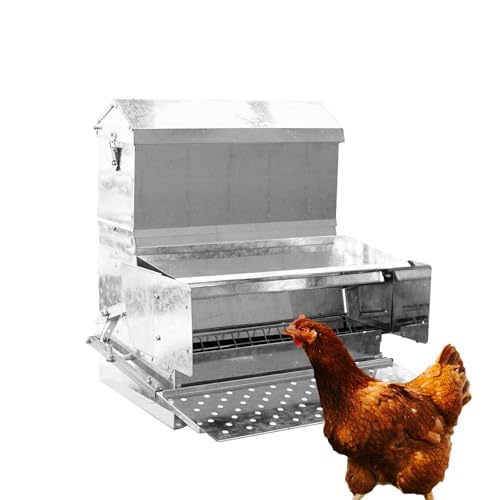
RentACoop 40 lb Automatic Treadle Chicken Feeder
The unit keepers cross-shop against the Grandpa's, at the same capacity for less money. Nobody in our harvest has run both, so buy it on price and on returns policy rather than on a durability claim we cannot back up.

VEVOR Automatic Chicken Feeder, 40 lb Rainproof Treadle
Full 40 lb capacity for a fraction of the Grandpa's, for the keeper who wants to find out whether their flock will even use a treadle before committing. No long-term keeper reports exist on it either way.
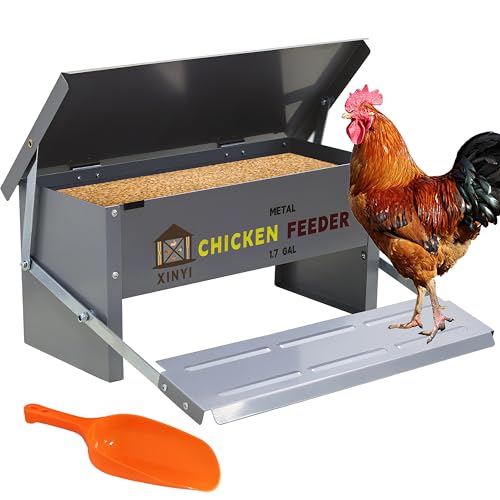
XINYI Chicken Treadle Feeder, 12 lb Metal
The small-run answer, for three or four hens in a compact setup where a 40 lb box will not fit against a wall. Twelve pounds is a weekly refill for a small flock, and the footprint is the reason to choose it.

No Waste Chicken Feeder Ports, 6 Pack DIY Kit
Buy this instead if your problem is feed flicked onto the ground rather than rats in the run. Six ports and a bucket stop the scatter for very little money, and they do nothing whatsoever to keep rodents out of the feed.
Frequently asked questions
Is the Grandpa's Feeders Automatic Chicken Feeder worth it?
This is the most expensive feeder in its category by a wide margin, and what it buys is feed security rather than anything the flock notices. That's a fair trade for a keeper losing feed to rats nightly and a poor one for everybody else. Treadle feeders at a third of the price exist, and nobody in the threads has owned one long enough for us to rule them out.
How is the Grandpa's Feeders Automatic Chicken Feeder built?
Galvanized steel body, lid and treadle plate, one moving part, nothing electronic. No owner in the threads reports rust, a bent panel or a broken hinge, and the longest report runs to a few years. Points come off for a jamming report where feed stopped reaching the lower tray, and for how few long-term owners there are to ask.
Is the Grandpa's Feeders Automatic Chicken Feeder reliable and safe for a flock?
Rodents and wild birds can't open it, and every owner report in the reports agree on that much. The weak half is behavioral. A treadle has to be learned, some flocks never learn it, and a feeder the birds refuse to use is a worse outcome than the problem it was bought to fix.
What do chicken keepers say about the Grandpa's Feeders Automatic Chicken Feeder?
Our verdict was that this feeder works and costs too much, and the reports agree firmly with the first half. Owners who have had one for years describe rodents staying out of the feed and nothing breaking. The evidence base behind that is small: thirteen posts, seven useful enough to publish, and only three of those seven written by somebody who owns a Grandpa's.