Orbit
Orbit Yard Enforcer Review: A Motion Sprinkler That Guards the Run by Day
Our verdict on the Orbit Yard Enforcer motion sprinkler: a genuine daytime predator deterrent, but it freezes in winter and needs a secure run.
By ChickenGearGuide · Updated September 2026
Independent editorial review. We never accept payment for coverage, though we may earn a commission if you purchase through our links.

Verdict
We usually lean this section on years of owner experience with a product. For the Yard Enforcer specifically we couldn't find substantial owner reports tied to this exact model, and we won't pin generic motion-sprinkler chatter to this SKU as if it were about this unit. So our verdict here rests on the published spec, on how a motion-activated sprinkler behaves in a yard, and on where it fits against the nighttime deterrents and the physical fixes we cover elsewhere. Read that way, the picture is consistent and a little sobering. As a daytime startle the design is sound: an infrared trigger, a sharp burst of water and noise, low running cost, and a build that shrugs off weather. The limits are just as clear from the design rather than from any one bad review: it freezes in winter, a persistent animal can habituate to it, it has to be aimed away from your own flock, and it does nothing to stop a predator that's already committed. That's why we score it as a useful layer over a secure run, not as protection in its own right.
Read full take ↓Similar predator deterrents
The Orbit Yard Enforcer is a motion-activated sprinkler, and our verdict is that it is a real deterrent for the daytime raiders a light does nothing about: the hawk that stoops on an open run, the neighborhood dog, the raccoon or fox that comes scouting while the sun is up. An infrared sensor watches an arc of your yard, and when something crosses it the head snaps on and throws a startling burst of water and noise. Animals hate the surprise, and most of them leave. Used the right way it earns its place. Used the wrong way it soaks your own hens, and it's worth being clear about which is which before you buy.
We haven't run one of these through a season on our own coop, and we couldn't find substantial owner reports tied to this exact model, so this verdict isn't built on our own year in the yard. What it rests on is the published spec, the way a motion-activated sprinkler behaves, and where it fits against the other deterrents we cover. Where the listing doesn't give us a number, like the exact reach of the sensor, we point you to the listing rather than invent one.
The one thing to settle first is what a sprinkler like this is for, because it's easy to expect too much of it. It's a deterrent, not a defense. It discourages an animal that has options and would rather not get wet, and it does nothing at all to stop a determined predator that has already decided your flock is worth it. The wire on your run and the lock on your coop are what protect the birds. The Yard Enforcer just makes the approach less pleasant, and that's a real job, as long as you don't ask it to be the wall.
The short version
What it gets right:
- Covers the daylight threats a night light misses: hawks, dogs, and bold daytime raccoons and foxes get a startling blast of water and noise
- Works day, night, or around the clock on a simple mode dial, so you can match it to when your threats actually show up
- Runs on four AA batteries and a standard garden hose, and sips water because it only fires a short burst when it's triggered
- Weatherproof, mounts on a metal spike you push into the ground, and doubles as an ordinary impact sprinkler when you want it to
What it gets wrong:
- It freezes. It runs on water, so in any climate with a hard frost it comes inside for the winter, exactly when some predators get hungriest
- It will soak your own flock if you aim it where the birds range, so it guards approaches and perimeters, not the ground your hens actually walk
- Animals can learn its pattern over weeks and start to ignore it, so it works best moved around and paired with other measures
- The plastic head and the battery door are the weak points, and a sticky valve or a dead set of batteries means it's quietly doing nothing
- It needs a hose run to it and enough water pressure to throw a real spray, which not every run has nearby
Which setups it fits
Reach for the Yard Enforcer if your problem is daytime and comes from a direction you can guard without spraying your own birds: a hawk working an open run, a dog that keeps testing the fence line, a raccoon that raids in daylight. Aim it to cover the gap between the tree line and the run, or the fence a predator climbs, while the flock stays on the far side of it. It pairs naturally with a nighttime deterrent, and our predator-proofing guide lays out where a sprinkler sits in the whole picture.
Skip it, or at least don't lead with it, in two cases. If your losses happen at night, a sprinkler that freezes and that you can't aim without also spraying a roosting flock is the wrong first buy, and a light or a hard physical fix comes first. And if the run has no hose nearby or weak water pressure, the thing can't do its one job, and you're better off spending the money on wire.
How it actually works
The mechanism is simple, which is part of why it holds up. A passive infrared sensor sits on the head and watches for the heat-and-movement signature of an animal crossing its arc. Trip it and a valve opens, the sprinkler head swings and fires a short, sharp burst of water, and the sudden motion and hiss is as much of the deterrent as the water itself. Then it resets and waits. Because it only runs on a trigger rather than continuously, a set of batteries and your normal water supply last a long time, and the water bill barely moves.
A mode dial lets you set it for day only, night only, or a full twenty-four hours, which matters more than it sounds. Left on around the clock it'll fire at every cat, possum and blowing branch all night and run your batteries and patience down, so most people match the mode to the threat: day mode against hawks and dogs, night mode only if that's when trouble comes and freezing isn't a problem. Sensitivity and the spray arc are adjustable on the unit, and getting those right, aimed at the approach and not the whole yard, is the difference between a useful guard and a nuisance that waters your boots every time you walk past.
Orbit rates the sensor to cover a broad arc out across a yard, but the honest number is the one you set in your own space: reach depends on how high you mount it, how you angle it, and what's in the way. Check the current coverage figure on the product listing, then plan to test and re-aim it a few times before you trust it.
Reliability, and what actually goes wrong
As a machine the Yard Enforcer is dependable in the way a garden tool is: few moving parts, weatherproof housing, a metal spike that holds it steady, and a sprinkler function that works whether or not anything trips it. Scored purely on build it's solid. The reason the reliability-and-safety score sits where it does isn't the hardware, it's the honest limits of what a sprinkler can do for a flock.
The first limit is winter. It moves water, so the first hard freeze takes it out of service, and in cold country that's months of doing nothing. Habituation comes next: a smart, hungry animal that returns night after night can learn the sprinkler is noise without consequence and start to ignore it, which is why every serious use of one treats it as a layer to move around, not a fixture to set and forget. Aim is the last catch. Point it wrong and it either misses the predator or, worse, drenches your own birds and their bedding, so it demands a spot where the flock can't cross its arc. And the batteries and valve are quiet failure points, so it goes on the same weekly walk-round as your waterers and your latches.
None of that makes it useless. It makes it a deterrent, which is exactly how our Nite Guard Solar review frames the nighttime light, too: a genuine layer that lowers the odds of a visit, sitting on top of a run that's already built to keep a determined animal out on its own.
The part that has to come first: the run
Because this is a safety product, one thing has to be said plainly and not buried. A motion sprinkler doesn't protect chickens. It discourages animals that have a choice, and a raccoon working at a weak latch or a dog digging under loose fencing has already made its choice. What keeps a flock alive is the physical barrier around it: a run clad in hardware cloth with a buried or aproned edge, a coop that locks with a raccoon-proof latch, and birds shut inside it at dusk. Get that right first. Then a sprinkler is a useful extra that keeps some threats from ever reaching the wire. Get it wrong, and no gadget on the market, this one included, will save the flock.
How it compares
The closest sibling is the Orbit 62120 Garden Enforcer, which is the same idea with a wider detection reach for a bigger yard or a longer approach; it costs more and its stock comes and goes, but it's the step up if the standard unit's arc won't cover your ground. Below it sit a raft of unbranded motion sprinklers that copy the design for a good bit less. They can work, but the sensor and the build are less proven, so they're the cheaper gamble rather than the sure thing.
The more useful comparison isn't to another sprinkler but to a nighttime deterrent, because they cover different shifts. The Nite Guard Solar is a red LED that mimics the eyes of a larger animal after dark, and unlike a sprinkler it doesn't freeze and doesn't need water or aiming away from the flock. A sprinkler owns the daylight; the light owns the dark. If predators are a real problem, the honest answer is usually not one or the other but both, over a run that's already secure.
The bottom line
The Orbit Yard Enforcer is a deterrent we would recommend for a specific job: turning away the daytime raiders, the hawks and dogs and bold daylight scavengers, from an approach you can guard without spraying your own birds. Aimed well it does that job honestly, it barely uses water, and it doubles as a sprinkler the rest of the time. Its limits are equally honest: it freezes in winter, animals can learn to shrug it off, it needs a hose and careful aim, and it never physically stops anything.
Final scores: Build Quality 7.0, Reliability and Safety 6.5, Value 6.5, which weight to an overall of 6.7. That's the score of a good layer, not a solution. Buy it to make the approaches to a secure run less inviting by day, pair it with a light for the night, and put your first and biggest money into the wire and the latches that actually keep predators out. Do that, and the Yard Enforcer is a genuinely useful part of the picture. Ask it to be the whole picture, and it'll let you down.
Our verdict
Weighted, not averaged: 35% build quality, 40% reliability and safety, 25% value. Safety counts for the most because this is gear where failure costs birds. How we score.
Build Quality
35% of the overall
Reliability & Safety
40% of the overall
Value
25% of the overall
Options Worth Checking Out
| Option | Role | The gist |
|---|---|---|
| Orbit Yard Enforcer | Our top pick | Our verdict on the Orbit Yard Enforcer motion sprinkler: a genuine daytime predator deterrent, but it freezes in winter and needs a secure run. |
| Orbit 62120 Garden Enforcer Motion-Activated Sprinkler | Premium option | The bigger-coverage sibling from Orbit: the same motion-and-water idea with a wider detection reach for a larger yard or a longer approach. |
| Motion-Activated Sprinkler (Unbranded) | Budget option | The budget option: an unbranded motion sprinkler at a good bit less. |
| Havahart Critter Ridder Motion-Activated Sprinkler | Alternative | Havahart's motion-activated sprinkler, a long-standing name in this category and the obvious cross-shop against the Orbit. |
| Nite Guard Solar NG-001 Predator Light | Add-on | The night-shift companion. |
Orbit
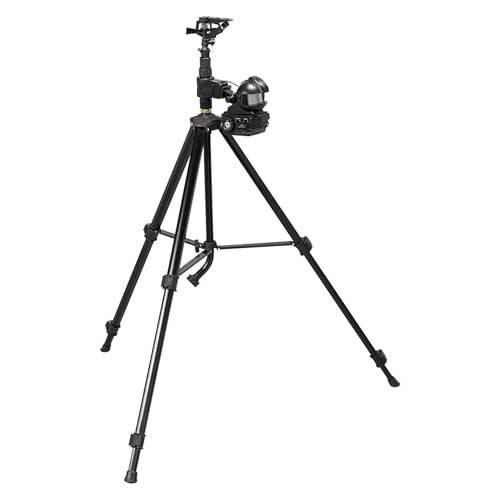
Orbit 62120 Garden Enforcer Motion-Activated Sprinkler
The bigger-coverage sibling from Orbit: the same motion-and-water idea with a wider detection reach for a larger yard or a longer approach. It costs more and stock comes and goes, but it is the step up if the standard arc is too small.

Motion-Activated Sprinkler (Unbranded)
The budget option: an unbranded motion sprinkler at a good bit less. The concept is identical, but the sensor and the build are less proven than Orbit's, so treat it as the cheaper gamble rather than the sure thing.

Havahart Critter Ridder Motion-Activated Sprinkler
Havahart's motion-activated sprinkler, a long-standing name in this category and the obvious cross-shop against the Orbit. Same principle: a sudden burst of water startles an animal off the ground it was crossing, with no harm done to it.
You Might Also Need
Accessories worth grabbing alongside your purchase
