Little Giant
Little Giant 9300 Incubator Review: The Cheapest Way In
Our independent verdict on the Little Giant 9300 still-air incubator: the cheapest way into hatching, but a foam box that punishes inattention.
By ChickenGearGuide · Updated September 2026
Independent editorial review. We never accept payment for coverage, though we may earn a commission if you purchase through our links.

Verdict
We usually lean this section on years of owner experience with a product. For the Little Giant 9300 we couldn't find that evidence tied to the model. Cheap still-air incubators get discussed constantly, but the discussion is about the class, several of them near-identical rebadges sold under rotating names, rather than this exact box, so pinning a report to the 9300 specifically would be guesswork. Our read on the class is straightforward, and it's where the score comes from. A still-air box has no fan, so the air layers and the eggs sit in hot and cold spots the lid reading never shows. Humidity is manual, filled and read by hand. Both of those are jobs a dearer machine automates, and both are where a cheap box loses a hatch. The value is real and the entry price is honest. The consistency is the part you're gambling on, and we have scored it on the spec and the still-air design rather than on owner reports we can't stand behind.
Read full take ↓Similar incubators
The Little Giant 9300 Digital Still Air Incubator is the cheapest honest way to find out whether you want to hatch your own chicks. It's a foam box with a heating element and a digital readout, and the word that matters most on the listing is still. Still air means there's no fan. We would buy it for a curious first-timer on a tight budget who's willing to sit with it, and we would point most other buyers at something that costs about twice as much.
The verdict comes down to that missing fan. With nothing stirring the air, the warm air stacks toward the top of the box and the cooler air pools near the floor, so the number on the lid isn't the number down at the eggs. A still-air box can hatch a full clutch, and it can also lose most of one to a few degrees of drift nobody sees until it's over. That inconsistency is the whole reason our Reliability and Safety score is a 5.5, and it's the reason a lot of first-timers should spend a bit more. Value is the one axis this box wins, and on its own that doesn't carry it.
We haven't run one of these, and one limit is worth stating before anything else. Detailed long-term feedback pinned to the 9300 by model is basically nonexistent as far as we can tell. Cheap still-air boxes get discussed a great deal, but the discussion is about the class, several of them near-identical rebadges, rather than this exact unit. So our verdict draws on what the listing gives, the incubation set-point every manual prints, and how a still-air box of this kind behaves. Whatever the listing withholds, we report as withheld and skip the invented spec.
The short version
What it gets right:
- It's about the cheapest way into hatching that still works, a fraction of what a forced-air incubator with a turner costs.
- It's a digital unit, so there's a temperature readout on the housing rather than a bare dial you eyeball.
- It's simple. A heating element, a thermostat, a readout, and water channels you top off by hand. Nothing to pair, nothing to update.
- The build is cheap in both directions. A replacement costs almost nothing, and Little Giant sells a Deluxe version with the egg turner already fitted, so the plain box is a starting point rather than a dead end.
What it gets wrong:
- Still air means hot and cold spots. With no fan, the temperature at the top of the box isn't the temperature at the eggs, and holding it steady is fiddlier than on a forced-air unit.
- Temperature drifts and the box gives you almost no warning, because the reading you can see isn't the reading the eggs feel.
- Humidity is manual. You fill the water channels and read a gauge, and how much water to run is a judgment the box does nothing to help with.
- The plain 9300 doesn't turn the eggs. Without the Deluxe turner you open the lid and turn by hand, several times a day, for most of three weeks.
- The listing publishes no egg count, so you can't plan how many eggs to set from the product page alone. Check the current listing before you buy.
Which flocks and setups it fits
Buy it if you're curious about hatching, you're on a tight budget, and you already know you'll fuss over it. A first-timer who wants a low-stakes trial run and doesn't mind babysitting a thermostat is the right buyer. So is anyone who wants to hatch a small batch once and isn't sure they'll do it again. For those keepers the low price is the point, and the fussing is part of the deal they're signing up for.
Buy something else if a failed hatch would gut you, or if you know you won't be home to check it. A still-air box with no fan and no phone alert is the wrong tool for a hands-off owner. If that's you, the Harris Farms Nurture Right below puts a forced-air fan, a turner, and the readouts in one box for about twice the money, and our guide to a first incubator walks through why that tier is where we send most beginners. Spend a little more and you're buying your way out of the exact failure this box is prone to.
There's a smaller fork for people the plain box otherwise suits. If the only part you dread is turning eggs by hand, you don't need a different brand. The Little Giant Deluxe is the same foam box with the turner already fitted, and it takes that one chore off you without changing anything else about how the box behaves. The fan evens out the hot and cold spots and the turner ends the hand-turning, so it fixes both of the 9300 limits.
The specs that matter
The 9300 is a still-air incubator, and that's the single most important line on the box. Still air means there's no fan moving the air around inside. The standard set-point every incubation manual gives is about 99.5F, or 37.5C, for a forced-air unit, and a still-air box like this one runs a little hotter, roughly 101 to 102F measured right at the top of the eggs, because nothing is mixing the layered air. We would treat that as the manual figure and confirm it against the insert that ships with the unit, not take it on faith.
It's a digital unit, so there's a temperature readout on the housing. We would still add an independent thermometer and hygrometer sitting at egg height, because the built-in reading is one point in a box that doesn't have a single temperature. Humidity control is a set of water channels you fill by hand. There's no pump and no automatic top-off on a box at this price, so the humidity is exactly as steady as you're about refilling and no steadier.
The plain 9300 doesn't turn the eggs for you. That's what the Deluxe version adds, and it's the upgrade we would reach for first. We couldn't find an egg-capacity figure on the listing itself, so rather than print a number that rots we'll say only this: check the current listing before you plan how many eggs to set. The one thing we'll stand behind is that this is a full-size tabletop foam box, not a countertop toy, and it takes more eggs than most first flocks need. For a controlled, forced-air alternative at the other end of the range, our Brinsea Mini II Advance review covers what the extra money buys.
How it keeps the flock safe
An incubator has one job. It holds a stable temperature and a workable humidity for about three weeks so eggs can become chicks. When it drifts, nothing dramatic happens in the moment, and that's the problem, because you don't find out until the hatch is over and you're counting what didn't make it.
Temperature drift is the failure a still-air box is built to have, and the reason is the missing fan. Warm air rises and stacks toward the lid, cooler air settles by the floor, and the eggs sit somewhere in between reading a temperature the display never shows you. A forced-air unit stirs that layering away. This one can't, so a warm afternoon in the wrong room, or a cold night, walks the temperature at egg height up or down while the readout on top looks calm. A few degrees for a few days is the difference between a hatch and a post-mortem, and a still-air box gives you almost no warning that it is happening.
Humidity is the other half, and the box hands it to you whole. Filling water channels by hand and reading a gauge means the number is only as steady as your refilling, and a hatch can fail on humidity as surely as on heat. We aren't going to hand you humidity targets or a lockdown schedule here, because that's hatching technique rather than a gear spec, and it isn't what this review scores. What we'll say is that this box automates neither temperature stability nor humidity, and that's two jobs left on your plate that a dearer machine takes off it.
None of that costs a live bird the way a coop-door failure or a heat-lamp fire can, so we aren't going to tell you never to buy it. The failure here's a clutch of eggs, not a hen. But it's three weeks of your attention riding on a box that drifts, and that's why the Reliability and Safety score sits at 5.5. The 9300 can do the job. It won't tell you when it has stopped doing the job.
Build quality and living with it
The build is exactly what the price implies. A foam shell, a heating element, a thermostat, and a clear lid. It's light and it isn't rugged, and a foam box wants a stable spot on a counter where it won't get knocked. The listing doesn't publish a wattage or a wall thickness, so we aren't going to invent one. The other side of cheap construction is useful: a replacement costs almost nothing and parts are easy to find, which is a real part of why a first-timer might start here rather than spend more.
Living with it is hands-on every day. You top off the water, you turn the eggs if you didn't buy the Deluxe turner, and you keep a second thermometer honest against the built-in one. That daily attention is the running cost of the cheapest box on the shelf. It asks for more of your time than any other incubator on this page, which is the trade you're making for the low sticker. For a couple of weeks that's manageable for most people, and it's worth knowing the shape of it before the eggs arrive rather than on day nine.
One habit we would build in from the start, with any cheap incubator: run it empty for a day or two before any eggs go in. A new foam-and-element box often gives off a faint smell the first time it warms up, usually the heating element burning off, and a dry run tells you whether that fades and whether the box holds where you set it. If it swings while empty, it'll swing worse once it's full and warm eggs are in it.
How it compares
The incubator we would put against it for most first-timers is a forced-air unit with a built-in turner, and the Harris Farms Nurture Right is the one that fills that role. A fan evens out the hot and cold spots that still air creates, the auto turner ends the hand-turning, the readouts are built in, and it holds 22 eggs. It costs roughly twice what the 9300 does, and for a nervous first-timer that's often money well spent, because it buys its way out of the exact drift the foam box is prone to. If a lost clutch would break your heart, that's the trade we would make.
If the plain box appeals but the hand-turning doesn't, the Little Giant Deluxe is the smaller step. Same foam shell, but it adds a circulating fan and a factory turner. The fan evens out the hot and cold spots and the turner ends the hand-turning, so it fixes both of the 9300 limits. It's the right call for someone who has decided on a Little Giant and just wants to stop opening the lid.
At the top of the range sit the small precision boxes. We reviewed the Brinsea Mini II Advance separately: it holds far fewer eggs than the 9300 and costs several times as much, and what you pay for is a sealed forced-air box that holds its set point where a foam still-air box drifts. That's a different buyer entirely, someone hatching small batches for years rather than trying hatching once. The 9300 isn't competing with it. The 9300 is competing with not hatching at all, which is most of the case for buying it.
Setting it up
Set it up before you have eggs, not the day they arrive. Put the box somewhere the room temperature barely moves, away from a sunny window and away from a heating vent, because a still-air unit tracks the room more than a forced-air one does. Give it a level spot where it won't get bumped, and run it empty for a day or two to watch whether it holds where you set it.
Add your own instruments. A cheap thermometer and hygrometer sitting inside the box at egg height tells you what the eggs actually feel, which isn't always what the lid says, and on a box that has no single temperature that's the highest-value thing you can add. It costs less than a bag of feed. We would trust two independent readings that agree over one built-in readout every time.
Decide the turning question before you buy, not after. If you run the plain 9300, you're opening the lid and turning by hand for most of the three weeks, and every lid-opening drops the temperature and the humidity for a while. If that sounds like more than you'll keep up with, buy the Deluxe with the turner fitted, or step up to the Nurture Right, and take the decision off your own plate. This is gear setup, not a hatching guide, so for the day-to-day of running a hatch we would point you to your own research and a good extension bulletin rather than a schedule here.
The bottom line
We would buy the Little Giant 9300 for one reason. It's the cheapest way to find out whether hatching is something you want to keep doing, and a still-air box works often enough that the gamble is real rather than hopeless. For a curious first-timer on a budget who'll sit with it, add a thermometer at egg height, and accept that some eggs won't make it, it's a fair place to start.
We wouldn't buy it if a lost clutch would break your heart, or if you can't be home to babysit a thermostat. Those keepers should buy the Nurture Right and pay the difference. The ones who only dread the hand-turning can stay in the family and get the Little Giant Deluxe with the turner fitted.
Final scores: Build Quality 5.0, Reliability and Safety 5.5, Value 7.5, which weight to an overall of 5.8. That lands it in the narrow-case band, which is where we think it belongs. The value is real and the price is honest. The consistency the still-air design gives up isn't, and no amount of good value buys that back. If substantial owner reports tied to the 9300 by model ever surface, Reliability and Safety is the number most likely to move. Until they do, we'll report what we couldn't verify instead of gilding a guess into a finding.
Our verdict
Weighted, not averaged: 35% build quality, 40% reliability and safety, 25% value. Safety counts for the most because this is gear where failure costs birds. How we score.
Build Quality
35% of the overall
A foam shell, a heating element, and a thermostat. Light, cheap, and not rugged, which is what the price implies. The listing publishes no wattage or wall thickness, so we don't print one. The flip side is genuinely useful: a replacement costs almost nothing and parts are easy to find. This is a low score because the build is genuinely low-end, not because we have a report of it failing.
Reliability & Safety
40% of the overall
The weak axis, and the reason to think hard before buying. Still air means no fan and real hot and cold spots, so the temperature at the eggs drifts and the box barely warns you, because the reading you can see isn't the reading the eggs feel. Consistency is the whole job of an incubator, and the still-air design is exactly what undercuts it. A foam box can hatch a full clutch and it can lose most of one, and it won't tell you which is happening.
Value
25% of the overall
The strongest axis and the whole reason to consider it. Nothing else gets you into hatching for this little, and a still-air box does produce real chicks. The catch is the risk premium. A drifting box can cost a whole clutch, and a second, better incubator bought after the first disappoints eats the saving, which is why the value alone doesn't carry it to a recommendation.
Options Worth Checking Out
| Option | Role | The gist |
|---|---|---|
| Little Giant 9300 Incubator | Our top pick | Our independent verdict on the Little Giant 9300 still-air incubator: the cheapest way into hatching, but a foam box that punishes inattention. |
| Little Giant Deluxe Incubator w/Egg Turner | Premium option | The same foam shell, but with a circulating fan and a factory egg turner. |
| Harris Farms Nurture Right Egg Incubator with Auto Turner, Holds 22 Eggs | Alternative | Spend a bit more here instead. |
| Farm Innovators 41 Egg Digital Circulated Air Incubator | Alternative | For hatching at flock scale rather than kitchen-table scale. |
Little Giant
Little Giant Deluxe Incubator w/Egg Turner
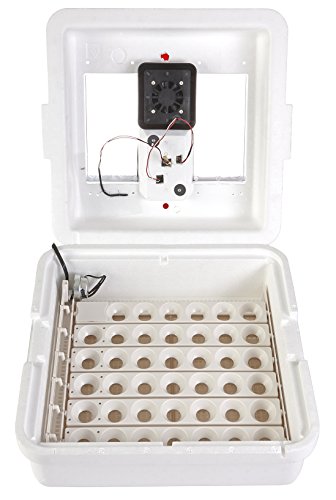
The same foam shell, but with a circulating fan and a factory egg turner. The fan evens out the hot and cold spots the still-air 9300 leaves, and the turner stops the several-times-a-day hand-turning. The step up if the drift or the turning would make you quit.

Harris Farms
Harris Farms Nurture Right Egg Incubator with Auto Turner, Holds 22 Eggs
Spend a bit more here instead. A forced-air fan evens out the temperature the still-air box cannot, the auto turner runs itself, and it holds 22 eggs. Buy this if you would rather not gamble a whole clutch learning on a foam box that drifts.

Farm Innovators 41 Egg Digital Circulated Air Incubator
For hatching at flock scale rather than kitchen-table scale. Forty-one eggs, circulated air and automatic turning, in a larger footprint with a plainer display than the top pick. Take this one when what you need is volume.
Frequently asked questions
Is the Little Giant 9300 Incubator worth it?
The strongest axis and the whole reason to consider it. Nothing else gets you into hatching for this little, and a still-air box does produce real chicks. The catch is the risk premium.
How is the Little Giant 9300 Incubator built?
A foam shell, a heating element, and a thermostat. Light, cheap, and not rugged, which is what the price implies. The listing publishes no wattage or wall thickness, so we don't print one.
Is the Little Giant 9300 Incubator reliable and safe for a flock?
The weak axis, and the reason to think hard before buying. Still air means no fan and real hot and cold spots, so the temperature at the eggs drifts and the box barely warns you, because the reading you can see isn't the reading the eggs feel. Consistency is the whole job of an incubator, and the still-air design is exactly what undercuts it.