PawHut
PawHut Large Wooden Chicken Coop Review: An 8-10 Hen Label on a 4-5 Hen Coop
Our independent verdict on the PawHut wooden coop sold for 8-10 hens: by the 4 sq ft rule it is really a 4-5 hen coop, and who should buy it.
By ChickenGearGuide · Updated September 2026
Independent editorial review. We never accept payment for coverage, though we may earn a commission if you purchase through our links.

Verdict
We usually lean this section on years of owner experience with a product. For this PawHut coop specifically we couldn't find that evidence. It's one of a rotating line of large wooden coops, sold across colours and near-identical sizes, and the long-term discussion that exists talks about the brand and the category rather than this exact listing, so pinning a quote to this unit would be guesswork. Our read on the class is straightforward. The printed hen count runs about double what the footprint supports, the softwood panels want sealing and warp if they don't get it, and the factory wire and latches are for keeping birds in rather than predators out. We have taken that as background and scored this coop on what the listing publishes plus the space math, not on owner reports we can't stand behind.
Read full take ↓Similar coops
The PawHut Large Wooden Chicken Coop for 8-10 Hens is a real coop from a brand you have probably seen on Amazon, and our verdict is that the label oversells the flock size by about half. It's sold for eight to ten hens. By the space a hen actually needs it's a coop for four or five standard birds, and closer to four once you count the run. That makes it a fair buy for a small-to-mid flock and the wrong coop for the big flock the box promises.
We reach that read the same way for every coop in this class, by holding the maker's hen count against the space a hen actually needs. The listing gives us numbers to work with, which is more than most: eighty-three by seventy-three inches for the whole structure, about forty-two square feet on the ground. Run the standard rule of roughly ten square feet of run per bird and forty-two square feet is outdoor space for about four hens, and that's before you subtract the floor the coop box itself stands on. Eight to ten doesn't fit in forty-two square feet. So the number on the label is close to double what the footprint supports.
We haven't held this coop, run it through a winter, or counted birds into it. People who've kept birds in this specific model for years barely register online, and the verdict carries that uncertainty on its face. So with owner reports thin, our read leans on the dimensions the listing prints and the ones it leaves out, and on how a branded wooden coop of this footprint compares to gear we do have evidence on. We keep the blanks blank instead of inventing a number to make the page look complete.
The short version
What it gets right:
- PawHut is a named brand you can look up, not an anonymous box that reappears under a new name every few weeks, which is worth something on a category full of rebadged imports.
- The listing actually publishes the overall dimensions, eighty-three by seventy-three by seventy-three inches, so you can do the capacity math before it arrives instead of guessing.
- It stands about six feet at the peak, a coop and an attached run in one structure, which suits a keeper who wants the flock housed and enclosed in a single footprint.
- For four or five hens it's a genuine coop and run at a mid price from a brand with a track record, which is the case it actually earns.
What it gets wrong:
- The eight-to-ten-hen claim runs about double what the footprint works out to. By the ten-square-feet-of-run rule the ground area is closer to a four-hen coop, and crowding eight birds in invites feather-picking.
- The listing publishes the outside dimensions but not the interior coop floor, the run floor, the wire gauge or the wood thickness, so you can't check the enclosed space or the predator claims before it arrives.
- Coops in this class run to flat-pack softwood that warps and wants sealing, small latches, and light wire rather than hardware cloth. We couldn't verify this exact unit against a long-term owner report.
- On its own it's a modest overnight predator barrier. The light factory wire keeps a hen in and does little against a raccoon with all night to work it.
Which flocks and setups it fits
Buy it for four or five hens and it does the job. A small-to-mid backyard flock, a first flock that isn't going to balloon, or a few standard hens plus a couple of bantams in a suburban yard with a fence and a dog patrolling the perimeter. In each of those the coop is holding four or five birds for sleeping and laying with a run to scratch in through the day, which is roughly what a forty-two square foot footprint is sized for. PawHut being a brand you can actually look up is the reason we would pick it over a no-name box at a similar price.
Send bigger flocks up a tier. If eight or ten hens will live here year round, this isn't the coop, and the better move is the brand's much larger 147-inch model or, better, a modest coop paired with real run space. A keeper in a wet or cold climate whose birds get shut in for days should size up too, because a coop this footprint with eight birds stuck inside becomes a feather-picking problem fast. Anyone in heavy predator country should treat the run as a daytime enclosure and put half-inch hardware cloth between the flock and the night, not trust the factory wire on its own.
The specs that matter
What the listing prints is more than the no-name boxes give you, and still short of what you want. The coop is wooden, it's rated for eight to ten hens, and the whole structure measures eighty-three by seventy-three by seventy-three inches in dark brown. That's close to the entire published spec. There's no interior coop floor dimension, no separate run measurement, no panel thickness, no wire gauge and no nest box count. Thin as this spec sheet is, the blanks are what matter, because the outside dimensions tell you the footprint but not how much of it is enclosed sleeping space and how much is open run.
So we hold the numbers we do have against the rule. Work through how much space chickens actually need and two figures do the job: about four square feet of coop floor per standard hen, and about ten square feet of run per bird. Eighty-three by seventy-three inches is about forty-two square feet on the ground. By the run rule that whole footprint is space for roughly four birds, and the coop box sits on part of it, so the enclosed floor and the open run are each a slice of forty-two square feet, not the eighty to one hundred square feet of run that eight to ten hens actually want. Halve the label and you land at four or five, comfortable at four. Bantams shift it a little in the coop's favor since a bantam needs less floor, and a flock that free ranges all day and only comes in to sleep can run tighter.
Before ordering, we would want the interior coop floor dimension and the run floor separately, and neither is in the listing. If you buy it anyway, measure the enclosed floor the day it arrives and divide by four square feet to get the real bird count for sleeping, then measure the run and divide by ten. Both numbers will almost certainly land below the eight to ten on the box.
How it keeps the flock safe
A wooden coop and run like this is a real daytime enclosure and a modest overnight barrier, and the safety score treats it that way. We can't quote a wire gauge because the listing doesn't publish one, and coops in this class ship with light wire rather than half-inch hardware cloth, plus small twist or hook latches. Light wire keeps a hen in and does almost nothing to stop a raccoon that has all night to work a latch or tear a staple. We say that as a read on the category, not as a report on this exact unit, because we couldn't find owner accounts of a break-in on this specific coop.
The safe way to run one is as a daytime run with the night handled properly. Wrap the run in half-inch nineteen-gauge hardware cloth, lay an apron of the same wire flat along the base so nothing digs under, and swap the factory latches for barrel bolts a raccoon can't paw open. (Digging predators dig at the wall, not a foot out from it, which is why the apron goes outward.) Ventilation still matters on a coop this size. You want vents up high, above where the birds sleep, so moist air escapes without blowing a draft across the roost. Damp, not cold, is what gives a hen frostbite, and a closed-up coop full of birds makes its own damp overnight.
Build quality and living with it
The build is a branded flat-pack, which reads a notch above an anonymous box and still leaves the numbers you want unprinted. PawHut sells a wide line of outdoor wooden pet and poultry structures, so this is a brand with a catalog and a track record rather than a name that vanishes next month. We can't quote a wood thickness because the listing doesn't publish one, and the pattern across flat-pack wooden coops is consistent: softwood panels want a coat of exterior sealant or paint at the seams and the roof before the first wet season, or they warp and let water in. Treat the raw edges on arrival and it holds up longer. Leave it bare and the weather finds the joints.
Living with it is a mid-size-coop experience. At about six feet to the peak there's more headroom than a small hutch, so cleaning is less of a crouch, though how much of that height is usable standing room the listing doesn't say. The nest area and the roost are shared across the flock, and for four or five birds that's manageable. Push it to eight or ten and the same capacity problem the numbers flagged turns into a daily fight with a cramped, hard-to-clean space and birds picking at each other.
How it compares
The obvious step up is PawHut's own 147-inch model, and it's worth seeing what the extra money buys. That one is a much longer structure, still listed for eight to ten hens, but across a footprint that gets closer to backing the claim. We would still halve its printed count for standing room, the same way we halve this one, so read it as a coop for a genuine small-to-mid flock rather than the ten on its label. It's the better buy of the two PawHuts if the flock is real, and we would trust its bird count no further than this one's.
Cross-shopped against the branded coops we have looked at, this lands in the middle. Our read on the Aivituvin AIR31 wooden coop and run is that it is a smaller, tidier two-to-three hen coop from an established maker, so the PawHut is the pick if you want more footprint and can live with the same missing interior numbers. Going the other way, the no-name budget wooden coop we reviewed is cheaper and much smaller, really a one-to-two hen box, and the PawHut is a real step up on it: a named brand, published outside dimensions, and a bigger run. All three share the same trick of printing an optimistic hen count, so none of them lets you check capacity before it arrives.
The better spend, if the real problem is room for eight or ten birds, isn't a bigger box at all. A twenty by ten foot metal walk-in run is two hundred square feet, which by the ten-square-feet rule is genuine outdoor space for a real flock, and getting birds out of the coop and into a run that size is what prevents the crowding a cramped coop causes. Pair a modest coop with a run like that and the flock is better off than it would be shoehorned into one grand-looking structure. That's the trade we would make.
Setting it up
Assembly is flat-pack, and the weak spot to expect on wooden coops like this is panels that don't quite line up and screws that strip the soft wood if you drive them hard. Go slow, don't overtighten, and pre-drill if the wood feels like it wants to split. Before it goes outside, give the whole thing a coat of exterior sealant or paint, the roof seams and the floor especially, because that one step is the difference between a coop that lasts a season and one that lasts a few years.
Then site it properly. Set the run on ground you can skirt with hardware cloth and an apron, not bare grass you're trusting the factory wire to hold overnight. Swap the small latches for barrel bolts. Keep the vents up high and clear, put clean bedding in the nest area, and stock it to four or five hens rather than the number on the box. Do that and it's a fair coop. Fill it to ten and you have bought the capacity problem the label sold you.
The bottom line
We would buy this coop for a small-to-mid flock and one only: four or five standard hens, or a few bantams, with the run wrapped in hardware cloth and treated as daytime space in predator country. For that it is a fair buy, and PawHut being a brand you can look up with real published dimensions makes it a step up on the no-name boxes at a similar price. As the eight-to-ten-hen coop the label promises, it's oversold, because a forty-two square foot footprint houses four or five birds honestly, not ten, and the build and wire are thin enough that you'll be sealing it and upgrading the latches sooner than you would like.
Final scores: Build Quality 5.5, Reliability and Safety 6.0, Value 6.5, which weight to an overall of 6.0. The number lands there for a legitimate product that suits one use and gets pushed for another it doesn't. If long-term owner reports on this exact coop surface, or the listing starts publishing the interior floor and the wire gauge, Build Quality and Value are the scores most likely to move. Owning the limits of what we could confirm beats selling you a guess with a finding's face on it.
Our verdict
Weighted, not averaged: 35% build quality, 40% reliability and safety, 25% value. Safety counts for the most because this is gear where failure costs birds. How we score.
Build Quality
35% of the overall
PawHut is a named brand with a catalog, and the listing publishes the outside dimensions, both of which sit above a no-name box. It stops short of a wood thickness or a wire gauge, and coops in this class are flat-pack softwood that warps and wants sealing, so the number sits mid-pack. We couldn't verify this unit's materials against a long-term owner report.
Reliability & Safety
40% of the overall
As a daytime coop and run it does its job, and a walk-in-height structure from a named brand is a real enclosure. As an overnight predator barrier the light factory wire and small latches are a modest defence, which is why we would only run it behind half-inch hardware cloth and an apron. How this coop keeps a latch or a seam through a winter is something no owner has reported back on, so we score it cautiously.
Value
25% of the overall
For four or five hens it's a fair branded coop and run at a mid price, which is what earns the value score. Priced and labelled as an eight-to-ten-hen coop it isn't, because by the four-square-feet rule the footprint is really a four to five hen coop, and the money past that is better spent on run space or the larger 147-inch model.
Options Worth Checking Out
| Option | Role | The gist |
|---|---|---|
| PawHut Large Wooden Chicken Coop | Our top pick | Our independent verdict on the PawHut wooden coop sold for 8-10 hens: by the 4 sq ft rule it is really a 4-5 hen coop, and who should buy it. |
| PawHut 147" Extra Large Chicken Coop Wooden Hen House for 8-10 Hens | Premium option | PawHut's much longer 147-inch wooden coop, still listed for eight to ten hens but across a footprint that gets closer to backing it. |
| 20x10 FT Extra Large Metal Chicken Coop, Walk-in Poultry Run Pen | Alternative | If the real problem is room, spend here instead of on a bigger box. |
| Omlet Eglu Go Compact Chicken Coop | Alternative | The compact coop we'd set a small-yard flock up in: wipe-clean plastic that starves mites, right-sized for two or three hens, and tidy in a suburban garden. |
PawHut
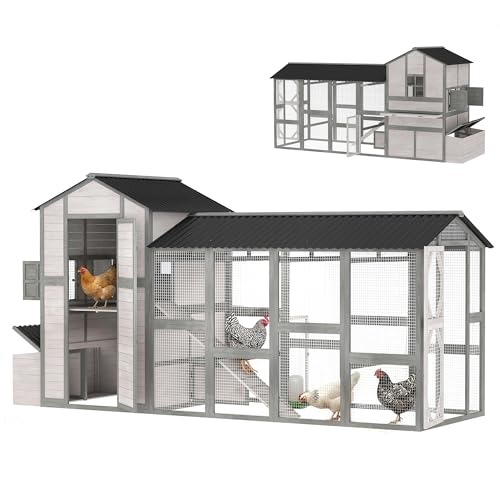
PawHut 147" Extra Large Chicken Coop Wooden Hen House for 8-10 Hens
PawHut's much longer 147-inch wooden coop, still listed for eight to ten hens but across a footprint that gets closer to backing it. The step up if the flock is real, though we would halve its printed count too and read it as a small-to-mid coop.
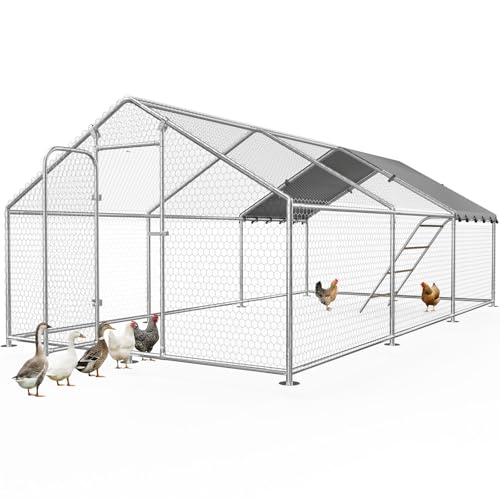
20x10 FT Extra Large Metal Chicken Coop, Walk-in Poultry Run Pen
If the real problem is room, spend here instead of on a bigger box. Twenty by ten feet of metal walk-in run is 200 square feet, genuine space for a real flock to get out of the coop, which is where crowding shows up. Pair it with a modest coop.
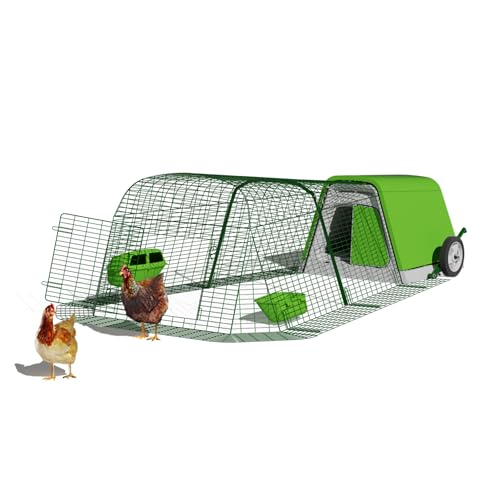
Omlet Eglu Go Compact Chicken Coop
The compact coop we'd set a small-yard flock up in: wipe-clean plastic that starves mites, right-sized for two or three hens, and tidy in a suburban garden. The price per bird is steep; what you're paying for is an easy-care footprint, not room.
Frequently asked questions
Is the PawHut Large Wooden Chicken Coop worth it?
For four or five hens it's a fair branded coop and run at a mid price, which is what earns the value score. Priced and labelled as an eight-to-ten-hen coop it isn't, because by the four-square-feet rule the footprint is really a four to five hen coop, and the money past that is better spent on run space or the larger 147-inch model.
How is the PawHut Large Wooden Chicken Coop built?
PawHut is a named brand with a catalog, and the listing publishes the outside dimensions, both of which sit above a no-name box. It stops short of a wood thickness or a wire gauge, and coops in this class are flat-pack softwood that warps and wants sealing, so the number sits mid-pack. We couldn't verify this unit's materials against a long-term owner report.
Is the PawHut Large Wooden Chicken Coop reliable and safe for a flock?
As a daytime coop and run it does its job, and a walk-in-height structure from a named brand is a real enclosure. As an overnight predator barrier the light factory wire and small latches are a modest defence, which is why we would only run it behind half-inch hardware cloth and an apron. How this coop keeps a latch or a seam through a winter is something no owner has reported back on, so we score it cautiously.