Aivituvin
Aivituvin Mobile Chicken Coop Review: A Good Tractor, Sized for Fewer Hens
Our independent take on the Aivituvin mobile chicken coop on wheels: a sound chicken tractor, but halve the 4-6 count and move it or make mud.
By ChickenGearGuide · Updated September 2026
Independent editorial review. We never accept payment for coverage, though we may earn a commission if you purchase through our links.

Verdict
We usually lean this section on years of owner experience with a product. For this exact mobile coop we couldn't find that evidence. It's one of several near-identical wheeled coops sold around the 82.4 inch length under rotating names, and the long-term discussion that exists talks about chicken tractors as a format rather than this listing, so pinning a quote to this unit would be guesswork. Our read on the format is straightforward. Moved every day or two, a tractor genuinely delivers fresh forage, spread droppings and no permanent mud patch, and the wheels are what make that happen. Left parked it gives you the mud and the predator exposure with none of the grazing, the printed hen count runs about double the space, and the open bottom that lets the birds graze is the same thing that stops you burying a predator apron. We have taken that as background and scored this coop on what the listing publishes plus the space math, not on owner reports we can't stand behind.
Read full take ↓Similar coops
The Aivituvin Mobile Chicken Coop with Wheels gets the idea right and the number wrong. As a chicken tractor, a small coop and run on wheels that you roll onto fresh grass every day or two, it does something a fixed coop can't: the birds get clean forage, the droppings spread across the lawn instead of piling in one spot, and you never build the permanent mud patch a stationary run leaves behind. The wheels are the part that makes that realistic, because a tractor you can't move easily is a tractor you stop moving. Our verdict is that the concept is sound and the rated four to six chickens isn't. Read it as a two to three hen unit, and only if you actually move it.
We reach that count the same way for every coop we look at, by holding the maker's number against the space a hen needs. About four square feet of coop floor and roughly ten square feet of run per standard bird is the rule keepers use. Six hens by that rule want a run near sixty square feet, and a wheeled unit has to stay narrow and light enough for one person to move, so it can't carry that and still roll. Prefab hen counts in this category tend to run about double what the footprint supports. Halve four-to-six and you land at two to three, comfortable at two or three birds that spend the day foraging and only come in to sleep.
We haven't held this coop, wheeled it across a lawn, or run it through a winter. Owners with years on this exact mobile model rarely show up online, so we score it with that gap named rather than hidden. The listing itself publishes one overall dimension, 82.4 inches, and we couldn't get a width, a height, an interior floor or a run footprint out of it. So this review rests on what the listing does and doesn't publish, on the space math, and on how a light wheeled coop in this class compares to gear we do have evidence on. Gaps in the listing stay gaps in our review, with no fabricated numbers slipped in to smooth them over.
The short version
What it gets right:
- The tractor concept is good. Move it every day or two and the flock grazes fresh grass, the droppings fertilise the lawn instead of concentrating, and you never create the stripped mud patch a fixed run leaves.
- It has wheels, and that's the feature that decides whether a tractor works. A coop you can move in a minute is a coop you'll actually move, which is the whole point of the format.
- The listing names a run, two nest boxes, a pull-out tray and a leak-resistant asphalt roof, which is more real spec than the no-name boxes publish, and the asphalt roof is a genuine step up on bare board.
- Aivituvin is a named brand rather than an anonymous import that reappears under a new name every few weeks, so there's a maker to hold to the listing.
What it gets wrong:
- The four-to-six-hen count is about double what a movable unit this size holds. By the four-square-feet rule it's a two to three hen coop, and crowding six birds into it invites feather-picking.
- It only works if you move it. Park a tractor and leave it, and in a few days the grass under it is stripped to bare dirt and then mud, which is the exact problem the format is supposed to avoid.
- You can't predator-proof a tractor the way you proof a fixed run. It sits open-bottom on the grass so the birds can graze, which means no floor and no buried apron, and a light wheeled unit alone in open pasture overnight is a weak barrier.
- The listing publishes a single overall dimension and no width, height, interior floor, run footprint, weight, wood thickness or wire gauge, so you can't check the capacity or the build before it arrives.
Which flocks and setups it fits
Buy it as a real chicken tractor for a few hens and it fits. A first pair or trio of standard hens, or a few bantams, in a yard with lawn to rotate them across and a fence and a dog around the perimeter. In that setup the coop is holding two or three birds for sleeping and laying while they spend the day on fresh grass, which is roughly what a wheeled unit this size is sized for, and the rotation is doing real work: fresh forage, spread droppings, no fixed mud patch. That's the job it's good at, and the wheels are what make it stick.
Skip it for a few clear cases. If you want the coop a flock of four to six will actually live in year round, this isn't it, and the better move is a bigger fixed coop or a modest coop paired with real run space. If you know yourself well enough to know you won't move it every day or two, buy a fixed run you can skirt with hardware cloth instead, because a parked tractor gives you the mud and the predator exposure with none of the grazing benefit. And anyone in heavy raccoon or fox country should treat it as a daytime graze unit and shut the flock somewhere solid at night: don't buy this to be the only barrier between a light wheeled box and a predator in the dark.
The specs that matter
What the listing tells you is short. It's an Aivituvin mobile coop on wheels, red, with a run, two nest boxes, a pull-out tray and a leak-resistant asphalt roof, marketed as expandable and listed for ducks as well as chickens. The only measurement printed is 82.4 inches, a single overall figure with no axis named, so you don't know if that's length, and there's no width, no height, no interior floor dimension and no run footprint. There's no published weight, which matters more here than on a fixed coop, because a tractor you can't lift or roll on your own is one you'll stop moving. With so little on the page, what's missing is the finding.
So we hold it against the rule instead. Work through how much space chickens actually need and two numbers do the work: about four square feet of coop floor per standard hen, and about ten square feet of run per bird. Six hens want roughly twenty-four square feet of coop floor and sixty of run by that rule, and a unit that has to stay narrow and light enough to wheel doesn't carry that. A mobile coop trades capacity for the ability to move, on purpose, so its honest bird count sits below a fixed coop of the same price. Halve the four-to-six on the label and you get two to three, comfortable at two or three foraging birds. Bantams shift it a little in the coop's favor since a bantam needs less floor.
Before ordering, the numbers we would want are the interior floor dimension, the run footprint and the weight, and none of the three is in the listing. If you buy it anyway, measure the coop floor the day it arrives and divide by four square feet for the real sleeping count, and try wheeling it across the lawn empty before you decide how often you'll really move it. Both answers will probably land below what the label led you to expect.
How it keeps the flock safe
A tractor is a different safety problem from a fixed coop, and it's a harder one. The thing that makes it a tractor, the open bottom sitting on grass so the birds can graze, is also the thing that removes your best predator defense. On a fixed run you bury a hardware-cloth apron flat along the base so nothing digs under. (Digging predators dig right at the wall, not a foot out from it, which is why the apron goes outward.) You can't bury an apron around a coop you move every day, so a determined digger has a way in that a fixed run doesn't give it. Light welded wire rather than half-inch hardware cloth, small factory latches, a light wooden box: a mobile unit left alone in open pasture overnight is a weak barrier. We say this as a read on the format, not a report on this exact unit, because we couldn't find owner accounts of a break-in on this specific coop.
The safe way to run one is inside an already-secure perimeter. Move it around a yard that's fenced against dogs and foxes, or roll it into a shed or a hardware-cloth-walled enclosure at night, so the light coop is behind a real barrier while the flock sleeps. The small latches are the first thing we would swap, a barrel bolt with a carabiner through it instead of a twist catch, because a raccoon works a twist catch with its hands and has all night to do it. Ventilation still matters even on a small coop: keep the vents up high, above the roost, so damp air escapes without blowing a draft across the birds while they sleep. Damp, not cold, is what gives a hen frostbite.
Build quality and living with it
The build is set by the format. A tractor has to be light enough to wheel, so it's built from light softwood panels and thin framing, and that ceiling on weight is a ceiling on how solid it can be. We can’t quote a wood thickness or a wheel spec, because the listing publishes neither. The weak point to expect on a cheap wheeled coop is the wheels and axle. They take the whole load every time you drag the unit over uneven ground, and they're the first thing keepers replace on a tractor. The listed asphalt roof is a real plus here, because a shingled roof sheds water better than a bare board and is one less thing to seal, though softwood panels still want a coat of exterior sealant at the seams before the first wet season.
Living with it is a small-coop routine with a chore bolted on: you move it. The pull-out tray is the feature that makes daily cleaning a pull-and-dump rather than a reach into a low box, and on a unit this size that matters. Set against that is the move itself, which is easy on flat mown lawn and a fight on rough or sloping ground, and heavier once the coop is full. There's no walk-in access, so you clean and gather from outside through the doors. For two or three birds that's manageable and part of the trade for a coop that goes on wheels. For six it becomes a cramped daily fight, which is the same capacity problem the numbers already flagged.
How it compares
If you want a tractor that moves a bigger flock and survives being dragged, the step up is a metal-frame chicken tractor. The one we point to publishes an iron frame, a run, an expandable nest box and 85 inches of length, and calls itself a coop for five to seven chickens. We would still halve that count for standing room, but a metal frame takes the repeated stress of moving far better than light softwood, and that's the real reason to pay more for a tractor. Going the other way, if the real decision is mobile against fixed, our take on the stationary Aivituvin wooden coop and run is worth reading: a fixed coop is one you can skirt with a buried hardware-cloth apron, which a tractor never is, so in hard predator country the fixed unit is the safer buy even though it makes the mud a tractor avoids.
And if you're honest that you won't move it every day, the better spend is fixed space, not a wheeled box. A 20 by 10 foot metal walk-in run is 200 square feet, genuine outdoor room for a real flock, and you can bury an apron around the whole thing because it stays put. Pair it with a modest coop and the flock is better off than it would be under a parked tractor. The catch a fixed run brings back is the one the tractor solved, a permanent worn patch that turns to mud, so if you go fixed, read how to fix a muddy chicken run before the first wet spell, because deep litter and drainage are what keep a stationary run from becoming the swamp a tractor rolls away from.
Setting it up
Assembly is flat-pack, and the weak spot to expect on light wooden coops is panels that don't quite line up and screws that strip the soft wood if you drive them hard. Go slow, don't overtighten, and pre-drill if the wood feels like it wants to split. Check the wheels and axle bolts are tight before the first move, because those carry the load every time you roll it. Give the raw wood and the roof seams a coat of exterior sealant before it goes out, even with the asphalt roof, because the panels are what soak up weather.
Then set a rhythm, because a tractor is only a tractor if it moves. Move the unit a coop-length onto fresh grass every day or two, before the birds strip the ground under it to dirt. Site each stop inside a perimeter you trust against dogs and foxes, or plan to roll it into a secure spot at night. Swap the factory latches for barrel bolts, set the two nest boxes with clean bedding, keep the high vents clear, and give the flock the grass through the day so the sleeping box is only ever holding the two or three birds it's really sized for.
The bottom line
We would buy this as a genuine chicken tractor for a small flock, and for nothing else. Two or three hens, a yard with lawn to rotate them across, a secure perimeter, and a keeper who'll actually move it every day or two. For that it earns its place: fresh forage, spread droppings, no fixed mud patch, and wheels that make the daily move real rather than aspirational. As the coop a flock of four to six will live in year round, it’s oversold: the label runs about double the space. And as a park-it-and-forget-it coop it’s worse than a fixed run, because you get the mud and the predator exposure without the grazing that justifies the format.
Final scores: Build Quality 5.0, Reliability and Safety 5.0, Value 5.5, which weight to an overall of 5.1. There's a specific use where it's the right call and a much wider one where it isn't, and most buyers fall in that second group, so it sits here. If long-term owner reports on this exact mobile model surface, or the listing starts publishing an interior floor dimension, a run footprint and a weight, Build Quality and Value are the scores most likely to move. Until we get that, we would rather point out what stayed unconfirmed than float a guess and label it a finding.
Our verdict
Weighted, not averaged: 35% build quality, 40% reliability and safety, 25% value. Safety counts for the most because this is gear where failure costs birds. How we score.
Build Quality
35% of the overall
A mobile coop has to stay light enough to wheel, and that caps how solid it can be: light softwood panels and thin framing, with the wheels and axle the weak point to expect on cheap tractors since they take the load every move. The listed asphalt roof and pull-out tray are real pluses. No wood thickness or wheel spec is published, so we couldn't verify the build against any long-term owner report, and the number stays low.
Reliability & Safety
40% of the overall
The open bottom that lets the flock graze is also what removes your best predator defence, because you can't bury a hardware-cloth apron around a coop you move. Light wire, small latches and a light wheeled box alone in open pasture overnight is a weak barrier, so we would only run it inside an already-secure perimeter or shut the flock somewhere solid at night. Owner reports past the first season don't exist for this exact unit, so the score stays low rather than generous.
Value
25% of the overall
As a real chicken tractor for two to three hens you move every day or two, a wheeled coop with a run, an asphalt roof and a pull-out tray earns its keep, and the grazing rotation is worth real money against a fixed muddy run. It slips only if you read the four-to-six label as a main coop, because by the four-square-feet rule this is a two to three hen unit and the money past that is better spent on fixed run space or a sturdier metal-frame tractor.
Options Worth Checking Out
| Option | Role | The gist |
|---|---|---|
| Aivituvin Mobile Chicken Coop | Our top pick | Our independent take on the Aivituvin mobile chicken coop on wheels: a sound chicken tractor, but halve the 4-6 count and move it or make mud. |
| Iron-Frame Chicken Tractor with Wheels and Large Run, 85 inch, for 5-7 Chickens | Premium option | The step up when you want a tractor that survives being dragged. |
| 20x10 FT Extra Large Metal Chicken Coop, Walk-in Poultry Run | Alternative | For the keeper who knows they will not move a tractor daily. |
| Omlet Eglu Go Compact Chicken Coop | Alternative | The compact coop we'd set a small-yard flock up in: wipe-clean plastic that starves mites, right-sized for two or three hens, and tidy in a suburban garden. |

Iron-Frame Chicken Tractor with Wheels and Large Run, 85 inch, for 5-7 Chickens
The step up when you want a tractor that survives being dragged. It publishes an all-around iron frame, a large run and 85 inches of length for 5-7 chickens. Halve that count, but the metal frame beats softwood for moving.
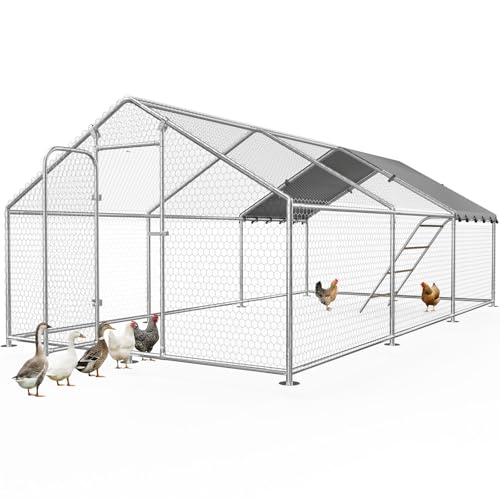
20x10 FT Extra Large Metal Chicken Coop, Walk-in Poultry Run
For the keeper who knows they will not move a tractor daily. Twenty by ten feet is 200 square feet of fixed run you can skirt with a buried hardware-cloth apron, which a tractor never allows. Pair it with a modest coop.
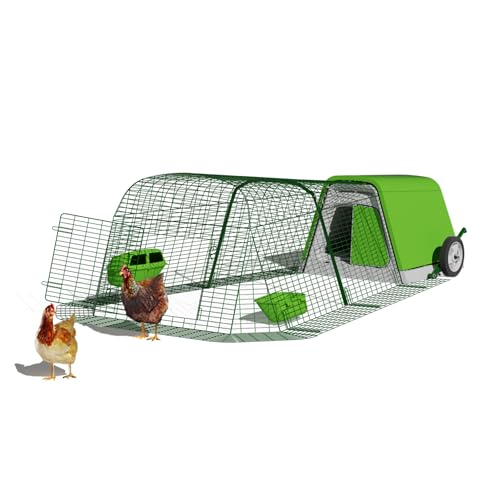
Omlet Eglu Go Compact Chicken Coop
The compact coop we'd set a small-yard flock up in: wipe-clean plastic that starves mites, right-sized for two or three hens, and tidy in a suburban garden. The price per bird is steep; what you're paying for is an easy-care footprint, not room.
Frequently asked questions
Is the Aivituvin Mobile Chicken Coop worth it?
As a real chicken tractor for two to three hens you move every day or two, a wheeled coop with a run, an asphalt roof and a pull-out tray earns its keep, and the grazing rotation is worth real money against a fixed muddy run. It slips only if you read the four-to-six label as a main coop, because by the four-square-feet rule this is a two to three hen unit and the money past that is better spent on fixed run space or a sturdier metal-frame tractor.
How is the Aivituvin Mobile Chicken Coop built?
A mobile coop has to stay light enough to wheel, and that caps how solid it can be: light softwood panels and thin framing, with the wheels and axle the weak point to expect on cheap tractors since they take the load every move. The listed asphalt roof and pull-out tray are real pluses. No wood thickness or wheel spec is published, so we couldn't verify the build against any long-term owner report, and the number stays low.
Is the Aivituvin Mobile Chicken Coop reliable and safe for a flock?
The open bottom that lets the flock graze is also what removes your best predator defence, because you can't bury a hardware-cloth apron around a coop you move. Light wire, small latches and a light wheeled box alone in open pasture overnight is a weak barrier, so we would only run it inside an already-secure perimeter or shut the flock somewhere solid at night. Owner reports past the first season don't exist for this exact unit, so the score stays low rather than generous.
